Showing posts with label Economics. Show all posts

Wednesday, December 20, 2017

Zimbabwe Primer: Major Urban Consumer Concentrations

Since Zimabwe is in the news: a quick analysis on the consumer class in the major cities of Zimbabwe.  Read more here.

Friday, December 01, 2017

Why Do Economic Links Matter in Tackling HIV/AIDS?

For the One Campaign, Fraym created a Connectivity Index, which measures how people and goods move across Africa, to display how significant the economic interaction is between high-burden countries and their neighbors. A reduction in access to treatment in economic hubs like Johannesburg and Lagos could have negative impacts across the continent.


Read more here.

Tuesday, November 21, 2017

Why Nakumatt Went Down in East Africa

Using geostatistical techniques and on-the-ground expertise, Fraym explores why supermarket chain Nakumatt failed in East Africa with a case study in Kampala.  Read more here.

Tuesday, September 19, 2017

What’s so special about Kenya’s Generation BUMP?

The young African consumer class is a highly prized demographic. Yet finding them can be tricky. Fraym recently used geospatial data to identify and locate Nigerians who are 18-34 years old, educated, and have money to spend. We found 29 million of them and dubbed this valuable demographic slice, Generation BUMP.

What about Kenya?  The Kenyan economy is growing rapidly, while its capital Nairobi is a stand-out performer on the Fraym Urban Markets Index, ranking 10th on the continent for metropolitan economic activity, consumer power, and trade and travel connections. Using neighborhood-level data across the country, Fraym identified Kenya’s Generation BUMP.


Kenya’s Generation BUMP is estimated at roughly 4.5 million strong, with just over 1 million living in Nairobi. But more than just sizable, this group is:

Banked. More than twice as likely to have a bank account (83 vs. 39 percent)
Urban. Three times as likely to live in an urban setting (65 vs. 22 percent)
Mobile. Phone ownership is nearly universal among Kenyan BUMPers at 98 percent (vs. 83 percent for non-BUMPers).
Plugged-in. Media consumption is starkly higher. They are more than twice as likely to regularly watch television (76 vs. 34 percent) or read newspapers (45 vs 18 percent).

Watch this space for more geospatial demographic and consumer analysis in other markets.

Tuesday, September 12, 2017

Impact of Boko Haram on Urbanization

Much attention has been placed on the rapid population growth in metropolitan Lagos. As one of Africa’s megacities and the growth engine for much of western Africa, that focus makes sense. However, the rate of urbanization actually has been much faster in historically less urban states, particularly due to the Boko Haram conflict.

As countries in the Lake Chad Basin continue to defend and rebuild areas affected by the Boko Haram insurgency, food insecurity is swelling across Cameroon, Chad, Niger, and Nigeria. The terrorist organization has caused over 20,000 deaths and displaced 2 million people since 2009 due to both violence and the inability of communities to maintain their farming-based livelihoods.

Where are these dislocated populations going?


See the Story map at Fraym.io

Monday, August 14, 2017

The Great Scooter Convergence in Nigeria

Nigeria has been in the press lately as a poster child for inequality as the income gap between the wealthy and the poor is, by some measures, widening. The World Bank estimates that 86 million Nigerians, almost half the population, live in extreme poverty.

Another way to think about inequality is to look at differences in asset ownership: do the poor possess assets that are associated with middle and upper-class standards of living?

We compared a decade’s worth of asset ownership data from household surveys and discovered an unexpected finding: ownership of scooters and motorcycles across different socioeconomic classes have converged.


Read more here.

Thursday, July 20, 2017

Corridors Are the Key

Today at Youth Connekt Africa ECA's Executive Secretary Vera Songwe noted the need to focus on cities and corridors for greater impact in job creation with data and analysis from Fraym.

Thursday, June 22, 2017

Where are Nigeria’s most dynamic consumers? Introducing Generation BUMP

Kupanda Capital wanted to sharpen its approach to building media and creative companies in Nigeria, Africa’s largest consumer market. They needed to understand which demographic segments were driving these sectors and where they were concentrated. Kupanda partnered with Fraym to use our proprietary geospatial platform to identify young, educated consumers with spending power.

What we found is a special group of Nigerians who are highly Banked, Urban, Mobile, and Plugged-in. We found Generation BUMP.


Kupanda is now using Fraym data at the neighborhood level to pinpoint where these 29 million valuable consumers reside across Nigeria. Watch this space for more analysis from Fraym locating this dynamic demographic in other African markets.


Technical note: To answer this question, Fraym harmonized and enhanced data from a variety of large representative household surveys and other data sources (including UN population, USGS Landscan, and the GeoData Institute) and then applied layers of analytical and econometric methods (including survey-to-survey imputation, small area estimation, and geospatial interpolation).

Thursday, May 18, 2017

Fraym's Africa Urban Markets Index

Africa is in the midst of a massive and historic transformation. Rapid urbanization, rising incomes, a youth bulge, and the diffusion of technology are combining to create exciting future centers of economic growth and opportunity. Richard Florida wrote in Rise of the Creative Class that “human creativity is the ultimate economic resource” and that “denser cities are smarter and more productive.”

Yet, very little data are available about Africa’s burgeoning urban clusters. Most economic, social, and consumer data are provided on a national basis or through costly one-off surveys. Fraym’s proprietary data platform can do better.

For anyone wanting to pinpoint Africa’s largest, wealthiest, and most networked populations, we created the Fraym Urban Markets Index. The Index estimates and ranks every geographic cluster on the continent with at least 300,000 people (n=169 cities) on three dimensions:

  • Economic activity. What is the GDP for the city’s actual geospatial footprint? 
  • Consumers. How many people live in a home with a car, motorbike, television, or refrigerator? 
  • Connectivity. How networked is the city by trade and air travel? 


Three highlights from the Index:

  • Cairo, Cairo, Cairo. The clear winner is Egypt’s capital, which tops the overall index and each of the three dimensions. While Johannesburg (2) and Lagos (3) are not surprising, some of the other Top 10 may be more unexpected, like Luanda (4), Kinshasa (5), and Khartoum (8). 
  • West Africa > East Africa. In fact, the consumer class of Lagos is roughly the same size as all thirteen cities in the East African Community combined. 
  • The Franco-underdogs. Several lesser-known Francophone cities far outranked better-known English-speaking capitals. Douala (23), Yaoundé (24), Ouagadougou (26), and Bamako (28) all outranked Lusaka (30), Kampala (37), Harare (51), and Kigali (61). 
Read the full Fraym Urban Markets Index paper with methodology and more takeaways (including a few other surprises) here.

Wednesday, November 09, 2016

The Weak Suffer What They Must For the Greater Good?

By allowing people to declare their opinion on any event, Facebook has made it difficult to sway people's arguments using logic (or evidence), since we are less prone to change our mind if we have to redact our opinion or admit being wrong.  Which is why I try not to engage in debates on social media.  Nevertheless, perhaps this will take my mind off Trump.  This is by no means a research paper but all self selective citations are at the end of the post.

On a morning when Donald Trump is the new President-elect in America, I am hit with my friends and colleagues rejoicing in NaMo's demonetization plan to combat 'black' money, calling it "brave, bold, decisive, incisive" and other superlatives.  However, this issue is not, if you will pardon the pun, as black and white as one might initially think.

For the uninitiated, this is what happened.  On Nov 8, at 8 pm, Indian Prime Minister Narendra Modi announced that effective that moment, all 500 and 1000 denomination currency notes will no longer be legal tender.  He explained that this decision will help curb black money and counterfeiting.  You can read a detailed account of what happened in this Reserve Bank of India press release.

Who would not be excited at the prospect of a "bold and decisive" government policy to curb black money, eh?  Certainly the neoliberals sitting in their ivory towers on Facebook love this idea. While the perceived intention of the policy is along the right lines, there are some issues worth considering here.

Modi's sudden call to demonetize, seems much like his earlier schemes like Jan Dhan Yojana... a jumla.  However, while the opening of millions of ‘zero balance’ bank accounts under the Jan Dhan Yojana was a harmless gimmick, the ill-conceived monetary decision this time will inflict costs on the public.

First, nobody knows how much black money is actually in cash, and how much in other tangibles (Hindustan Times).  The 2012 report on the 1978 Janata Dal/Morarji Desai demonetization found that the majority of black money is in benami land, gold, and off-shore accounts.  It did little to combat black money in the "long run". I will admit that there are stronger tracking systems in place now, but there are also knew avenues of laundering (Indian Express).  The big fish have long devised much more sophisticated ways of stashing their money.  The current demonetization is unlikely to touch anything more than a fraction of the present stock of black money in India (HT).

This is what the policy has done so far: In Gujarat, sale of gold increased on 9 November with an increased 20 to 30% premium as people bought gold in exchange of their unaccounted cash.  The Hindu reported that such transactions have been made back dated.  The targets for this policy is already gaming the system, and the working class that barely have any money, let alone black money are the ones paying the toll  (The Hindu).  The liberal elite do not seem to understand this, calling it "a minor inconvenience that will be over in a week".  The worst statement I have read is a comment: "We have to take care of our domestic helps, that's our responsibility."

Having said that, there is definitely an argument to be made for this policy to lower corruption at the mid-level.  My friend Tanmay Shukla made an argument, which I am going to paraphrase:

When folks with black money buy a house in India, to avoid stamp duty people pay half in cash right?  Not jewelry or bullion or other properties.  When a bureaucrat pays another to get a promotion he has to use cash to avoid a second round of negotiations over the value of what he is offering as bribe.  Politicians, whose main reason for being corrupt is that they need a lot of funds, and need to make a lot of payments to stay in power.  So disrupting the currency supply should disrupt corruption.  We are not sure why it did not work in 1978 but casual observation goes against this idea that black money is not stored in cash.  However, one problem with this initiative is that it disrupts the flow and not stock of black money.  It can temporarily cripple people and make them fearful of being corrupt, but then Modi has to take advantage of their handicap to force a more permanent change.  We don't know what he is up to behind the scenes so it might be worthwhile to wait and watch.  Then again it might not.

Second, the demand for Aadhar and PAN cards while exchanging these notes at banks or the post office is an affront to the poor - most of whom are without these documents or the cultural capital to haggle with the institutions demanding them.  According to UDAI statistics, as on Nov 2016 about 80% of the total population have an AADHAR (1.07 billion issued) identification card.  Not including children, that leaves about 200 million people with no way to work around this policy. (UDAI stats shows more than 100% issuance rates for some states, so I would take their numbers with a grain of salt - this is not the first time the administration has inflated numbers, remember the new GDP estimators?)

Moreover, getting an AADHAR card doesn't happen overnight, particularly in remote places - what will they do in the meantime?  I think it is unfair to justify a "long term solution" with such a massive cost, which can have enormous long-term consequences.  Having an attitude that the poor can deal with this minor inconvenience for a couple of days, is naive and high-handed.  The government can do issue some studies of the expected cost to the economy and tax payer through demonetization and re-issuance, and some evidence to support that the black money recovered or destroyed will significantly trump that, otherwise it is simply not justified.  I want to see the mathematical logic of why and how this will work, especially since it did not in 1978.  I can't believe I am actually siding with Mamata Banerjee and Sitaram Yechury on this issue.

The government pushing for demonetization and asking the Reserve Bank to tag along also brings to question the separation of powers between the executive and the central bank.  If this excerpt from former RBI Chair Raghuram Rajan, is anything to go by, I do not think he would have supported it.
"There are alternatives to fighting..."
The decision has created chaos (Reuters), ordinary folks who work on daily wages are stuck with worthless cash and cannot buy basic supplies.  Certain shops are charging a 4:5 ratio to convert cash because banks and ATMs are shut - the BSE SENSEX tanked 6.3% and is forecast to lose more as the economy comes to a grinding halt over the next few days.  It is all good if you have a card and shop at Metro Mart, but it is a difficult disaster to survive for a substantial chunk of the country - the informal economy, which contributes about 20% to the GDP (Guardian).

Starting the 11th of November banks and post offices will allow people to convert their old bills for smaller denominations, but there is also a limit to cash conversion - Rs. 4000 per day.  The cost to banks and folks going to the bank to convert their money everyday will be stressful and hurt business.

Markets in Calcutta were closed today as the majority with purchasing power have very little low denomination cash on hand.  ATMs and banks are closed till the 11th - so what do we do in the meantime?  People are panicking because not everyone has plastic, in fact, the majority live on daily wages, so if you're sitting on Rs. 1,500 in 500 rupee notes and no one is accepting them and you have to change it in a bank and you don't have an ID - you do what anyone else would do - you panic.

Additionally let's not forget the Muslim population who do not use traditional banking systems - they are left out in the cold.

Finally, the skeptic methinks this is a ploy to reduce cash circulation as the UP elections are coming up to prevent ballot capturing.  The idea of issuing 2000 rupee notes will simply reset the system, so how is this a long term solution?  (Economic Times)

The arguments that this policy will do wonders for promoting e-commerce as well has the whole "India Shining" issue written all over it.  As for the contribution of this move in combating terrorism, it is a red herring.  The role of opaque instruments like Participatory Notes, used by FIIs operating in the Indian stock market, are more relevant for financing terrorism than Indian currency notes of high denomination (HT).  However, there is an argument to be made for the short-term increase in the value of the Rupee as there will be a heavy liability lift on RBI's books.

As Prosenjit Bose writes: 

"The real problems ailing the Indian economy lie elsewhere. The amount of stressed loans in the Indian banking system has crossed a whopping Rs. 9 lakh crore, a bulk of which is owed by domestic corporations to the public sector banks, causing a huge debt overhang.  Despite doubtful claims of fast economic growth, revenue mobilization has not shown any signs of improvement and consequently, re-distributive policies have been rolled back.

Under the Modi regime, substantive measures to promote investments, economic growth, revenues and welfare expenditure have been supplanted by gimmicks, PR spins and a brazen pursuit of select corporate interests. The latest instance of a conflict of interest lies in today’s full page newspaper advertisements by an online payment service provider congratulating the Prime Minister for the demonetization announcement."

It seems that the argument is that it is okay for a government to destroy the wealth of several hard working and honest citizens some of whom are in the poorest strata of society because they have no recourse (I include myself in this as I am sitting on cash here in the US and in my apartment in Calcutta that will essentially go to waste) @ 11,000 crore rupees cost to the tax payers to print new money (not including all the legitimate cash that will be destroyed and loss to business and waste of time and energy), create chaos and confusion, slow down the economy, disrupt regular business, not catch any of the really big fish because they have land, gold, and offshore accounts, make no arrests, and reset the black money counter in February after the elections?

Oh, and by the way, those Whatsapp messages your aunt sent you about nano GPS trackers in the new 2000 rupee notes is a hoax.

So what are the alternatives to this sensationalist stunt that hurts the working population instead of actually hitting the real criminals?  For starters, let us get a better understanding of why people engage in the black money economy.  Admittedly, the initiatives by the government to renegotiate the double taxation agreements with Cyprus and Switzerland - great idea.  Convictions based on Panama Papers - super.  Tougher auditing measures - great.  All of these target the top 1% who have about 74% of India's documented and undocumented wealth.  Can we give the poor some respite for a change and hit the ones who really need a punch in the bracket?

16 Nov 2016 Edit: The PM has asked for patience till Dec 30 - I will wait, I wonder if the poor can...

Resources and articles:


Wednesday, February 04, 2015

Fracking, Nuclear Power, and the Environment

Last October I visited the 605-megawatt Vermont Yankee nuclear power plant in Vernon while driving through New England and taking in the fall colors.  It was a nostalgic visit.  Several years earlier, I had worked on a study to determine contingency plans for the failure of Vermont Yankee, and in a few months, Vermont Yankee was going to become one of the early casualties of America's aging fleet of nuclear stations.  Perhaps the retirement of a small power station in the far corner of the northeast is not newsworthy, but in my opinion the shutdown of Vermont Yankee is a harbinger of a new era of the U.S. energy landscape.  The “nuclear free” story has deeper consequences than many recognize, however, as well as a more complex impact on the environment.  

The United States is the world’s largest producer of nuclear power, accounting for more than 30% of global nuclear electricity production.  Domestically, nuclear energy represents about 20% of the generation mix, but with the planned early retirements of nuclear stations, and new constructions under threat, by 2020 that contribution may shrink.  In the late 1990s changes in government policies helped pave the way for significant growth in nuclear capacity; however, lower natural gas prices since 2009 have put the economic viability of some existing reactors and proposed projects in doubt.  Oil and gas prices are at historical lows, and with shale and fracking promising to keep costs down, nuclear technology is no longer an attractive option for power.  Though the cost of nuclear fuel is considerably low, increasing safety and security concerns are pushing up the building and operating cost of nuclear production beyond gas-powered combined-cycle and coal units.  Today, the competitive advantage of a new nuclear power plant is questionable.  The five nuclear plants presently under construction have been stuck in financial and regulatory nightmares since 2009. Furthermore, the indelible memory of Three Mile Island and Chernobyl, coupled with the recent Fukushima disaster in Japan, is killing the dream of an American nuclear renaissance. 

In Japan, nuclear still has a competitive advantage over gas-fired plants since natural gas prices in Japan are considerably higher than the U.S.  This is why Japanese power companies are trying to restart their nuclear power stations after the automatic reaction of shutting down all fifty nuclear units in Japan after the Fukushima disaster in March 2011.  

In contrast, Germany is retiring its entire nuclear fleet in an attempt to move to safer and cleaner renewable power but in the process caused coal prices to increase dramatically and create a spike in energy prices.  Additionally, even though wind and solar provide clean energy, the capital requirements and maintenance costs of renewable power, particularly offshore wind and solar, is significantly higher than for nuclear technology, making gas units a more attractive replacement for nuclear in the United States.

What do these factors mean for the U.S. energy landscape?  Power prices are low; the lights still come on when we flip the switch, so why should we care if a few nuclear power plants are retiring?  First, a recovering U.S. economy is driving up energy demand and sparking a series of new gas-powered plant constructions since gas prices are so low.  Second, some industry experts are concerned that the increasing shale gas production through fracking, which has helped keep oil and gas prices low, is unsustainable.  If gas prices increase in the near future, overall energy prices will increase, adversely affecting the weakly recovering industrial sector.  More than a long-term increase in power prices, however, retiring nuclear power generation has a concerning yet ignored underlying environmental story.  

Industry analysts estimate that the early retirement of the 2000-megawatt San Onofre (SONGS) reactor complex north of San Diego will increase California’s greenhouse gas emissions by up to 6 million tons per year, which is almost a 12% increase of emissions from the electricity generation sector in California.  Energy expert Geoffrey Styles comments: “While accounting for only 3% of the state’s [California] 2011 generating capacity from all sources, the SONGS reactors typically contributed around 8% of the state’s annual electricity generation, due to their high utilization rates. That’s a large slice of low-emission power to remove from the energy mix in a state that is committed to reduce its emissions to below 1990 levels.”  With aggressive targets to reduce greenhouse gases, the loss of existing U.S. nuclear capacity, which has negligible emissions, is a major setback, particularly since renewable energy cannot completely offset the energy generation gap.  California is not the only state that faces this challenge.  The retirement of the Indian Point nuclear station in New York will have a similar effect.  Moreover, the primary economic driver (gas prices) that is making nuclear power financially unfeasible is also contributing to the most amount of environmental damage—“fracking.”  

Fracking is the primary reason for the plummeting gas price in the United States, which is now a quarter of the price in Europe, and shale gas accounts for more than a quarter of total gas production in the United States.  Hydraulic fracking is the process of stimulating liquid and gaseous wells through injecting high-pressure super-heated chemical solutions into shale deposits—a controversial process, as signified by New York state's  banning of it.  Apart from the potential environmental damage, there are health hazards such as methane leaking from fracking wells into the water table causing the phenomenon of “flammable water.”  Although a recent MIT report found that “only a handful of the 20,000 wells drilled in the previous decade had caused contamination,” the question remains: is cheap gas worth the risks associated with fracking?  While some pro-frackers argue that fracking is technically a “green” technology since gas has lower greenhouse gas emissions than coal, gas is still “dirtier” than nuclear technology.

In addition, decommissioning a nuclear power station is a regulatory challenge and expensive.  Entergy Corp., which owns the Vermont Yankee power station, estimates that cooling the reactor and permanently shutting down the plant will require ten years and about $1.5 billion.  Consumers will pay a large part of this cost through higher electricity rates.

In a deregulated energy market, where economics is the key driver for determining the resource mix, policy plays an important role in encouraging or discouraging forms of production, by taxation or credits.  Under present policy, low cost gas-powered units will replace the forced nuclear retirements— not an optimal outcome from an environmental perspective.  It is imperative that policy makers understand the long-term impact of these nuclear retirements when refusing nuclear license renewal and considering new plants.  Nuclear opponents cheer the net loss of nuclear power and may consider the replacement of nuclear with renewable technology as progress.  However, if fossil fuels, rather than renewables, replace nuclear, it seems more like a step backward.  A reasonable alternative might be a staggered long-term nuclear retirement strategy coupled with policies to promote renewable power through higher production credits or introducing often-discussed carbon taxes.  Although this is not a perfect solution, it should prevent fossil fuels from completely replacing nuclear and setting back achieving emission targets by several years.

Tuesday, June 10, 2014

Boo Boo Banking

I'm finding it rather hard to reconcile the dichotomy of free market banking system (and the greedy beast it has mutated into) and the requirement of a strong, regulated financial institution for development (and the bailouts they entail).  Allow me to elucidate.

It is imperative for an economy to have a strong banking system to allow the flow of capital between people who wish to seek a return on their earnings and people who require it to pursue business ideas.  The banking system is supposed to take the money from folks who do not require it at the moment and feed it into ideas. Traditionally the banking system invested in ideas with real world implications - i.e. businesses that were actually adding value to the economy.  Manufacturing cars, designing a new dress, or even researching the benefits of monkey poo.  All of this created real growth in the system, the bank made money and the people who invested in the banks received interest and viola, we had progress.  Simple enough?

Of course, there are caveats to this strategy.  How do we determine what is a good idea?  Can we know for sure that an investment will create positive returns in the long run?  The element of risk has always cast a shadow on the will to commit other people's money to a business idea.  

Government banking institutions, which are required to be solid, risk-less, and "blue chip", are averse to investing in ideas that are "edgy" or "untested" leaving a lot of interesting ideas unfunded and unrealized.  This gap is bridged by venture capitalists [1].  Good VCs very quickly realized that in a growing ADD market, 9 out of 10 ideas were prone to fail, but it was that 1 golden goose that was enough to cover all past misgivings.  Consider Sequoia and Google.  That is not to say that VCs will go to bed with anybody, but they truly embrace the golden maxim of investments - "no risk, no return".  

This system works great in an economy with low levels of information asymmetry, minimal bureaucracy, and the belief that good ideas are going to be funded.  Without this belief, perhaps a lot of great ideas die in our minds because we do not think that pursuing them will lead anywhere.  With this holy trinity, we can create a system where ordinary citizens can "dream".  We can give life to ideas, and move the economy in a forward direction, and create a new benchmark in development.  This, in modern parlance, we call "innovation".

Now consider a country like India or any other developing nation for instance.  We have such a primitive banking system, that we require to have collateral for student loans!  A risk averse banking system in an economy where there is no other alternative to raise funding, is a serious detriment to development.  Indian banks primarily target asset loans which assure the bank of a fixed return on the investment and SMEs and ideas are ignored as being too "risky".  Hence, even though people harp about India's massive human capital growth in the last decade, we, as a nation, have contributed minimally to global innovation.  A statement reiterated by Israeli Consulate General in Bangalore, Menahem Kanafi.

Much as we've come to belittle corporations and the world of finance as evil, they are definitely a necessary evil when we consider their impact on the real economy [2].  So the question we now need to ask is, do we leave the banking sector to its own devices and hope that the public awareness increases, or should governments regulate the market.  An age old question free market economists and Keynesians have been arguing for the last century.  Consider a return to these two videos I had posted in 2011.  I shall leave the argument about the inefficiency of central banking for another day.
Keynes vs. Hayek Round 1
Keynes vs. Hayek Round 2

However, modern financial systems have become an unmanageable beast.  Most of us are already aware of the massive implications of corporate greed in the 1998 Financial Crisis so let us take a more subtle example.  Let us use education.  
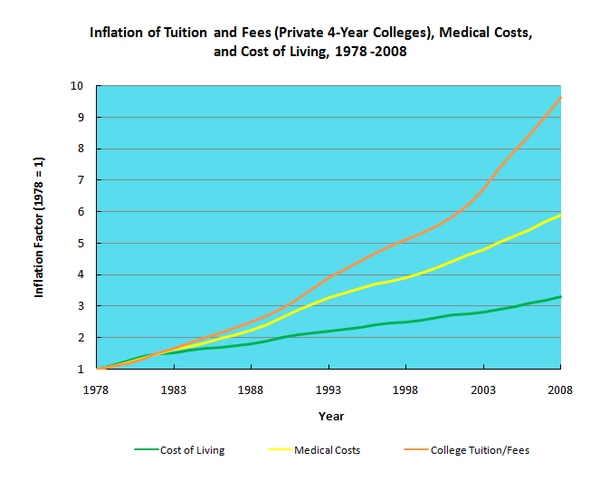
The above graph (CollegeBoard) shows that increase in college tuition fee has far exceeded inflation rates in the US.  Considering most colleges, at least, the state universities are non-profit institutions, what could be the reason behind this sharp increase in tuition fees?

There are several theories floating in the academic circles, including, a potential "higher education bubble", or a decrease in government appropriation into the education system, mismanagement of endowments, and lack of consumer protection.  Personally, I posit that the federal students loans program has played a large role in not only raising college tuition, but also herding our top engineering and science students into the corporate and banking sector.

Since the federal government started providing low interest student loans to make education more affordable, this increased the market for higher education, allowing universities and colleges to hike up their tuition fees by recognizing that now more students had access to money to afford these higher fees.  Unfortunately, this system led to students graduating college with massive amounts of debt, and instead of pursuing vocations they were really interested in, were forced into majoring in subjects that would provide the maximum employment opportunity upon graduation.  This phenomenon caused a large increase in students pursuing subjects like economics and finance, and of course, the ubiquitous MBA.

Why does an MBA cost so much when one can learn pretty much all the material through Khan Academy and a library card (read Good Will Hunting) in six months.  Well, first, it provides you with a stamp of legitimacy - we live in a paradigm of label-able education.  Although in my opinion, knowledge and literacy almost has nothing to do with being educated.  I have found many "MBAs" pretentious and arrogant [3].  Even worse is the increasing trend of engineers pursuing MBAs to take up corporate management positions, ridding the world of clever engineers and replacing them with greed infused suits.  Second, this "need" to do an MBA has made the demand for the degree sky rocket allowing schools to charge fees which in any other profession would be called highway robbery...

So, the banking system, through their loans, allows colleges to increase their tuition, encumbering students with massive loans so they end up taking jobs with the said banks after they graduate... an unusually unhealthy system.  Can we break down this system?  Should the US federal government stop giving out low interest loans?  Should education be completely free market?  Doesn't that skew the level playing field then?  Should governments cap tuition fees like in the UK, or make colleges free like in Europe?  Whoa, that sounds like socialism...  I don't have the answers, but it's something to think about.

Addendum: 24 September 2014
Here is John Oliver's ("Last Week Tonight with John Oliver") brilliant and hilarious take on the Student Debt Crisis, from an angle I had never considered before.  Consider meself suitably humbled.


[1] Understand that Investment Banks do not actually invest in ideas... they invest in existing businesses for vast commissions.  While IBs may also be adding to the real economy, they do not necessarily push for innovation.  An IBs primary goals are M&A, financing solutions, corporate consulting and risk management, and investment solutions.  This is vastly different from VCs.  Similarly, merchant, corporate and commercial banks do also invest into new businesses but deal with vast capital and not particularly with new ideas.

[2] Let us, for the sake of argument, ignore the manner in which banks create fictitious wealth through complex financial instruments that serve no purpose but to sponsor bonus checks.

[3] I remember a person once tried to get me to buy into an Amway type pyramid scheme, and when I painstakingly pointed out all the inherent fallacies in his arguments, he asked me with a sneer, "Do you have an MBA?"  "No", I had replied.  "Well I do, and I'm telling you this works."  Case closed.

Monday, May 12, 2014

"Regression analysis is more art than science" [1]

Steven Levitt and Stephen Dubner showed us in Freakonomics how the world of correlation and regression can show curious links between seemingly unrelated subject matter - culminating in a thesis relating legalization of abortion and crime rates in the United States.

Here is another view - Correlation can yield absolutely absurd results...
My favorite is "Divorce Rates in Maine" against "Consumption of Margarine in the US"

As Twain said, "There are lies, and then there are statistics"...

[1] Steven Levitt

Saturday, January 25, 2014

Where's My Global Development?

Article published by University of Virginia's Darden School of Business.

The Emerging Markets Development Club recently released some statistics on global equality and income...

The findings are, well, less than impressive... equitable distribution of wealth, where art thou?

Read the whole article.

Perhaps we should all be more like this chap.

Thursday, July 25, 2013

Great Student Resource for IB Economics

An excellent source of information for IB Economics students including Extended Essay, Internal Assessment and other video lectures...

Good luck!

Friday, July 12, 2013