Showing posts with label Ramblings. Show all posts

Tuesday, June 10, 2014

Boo Boo Banking

I'm finding it rather hard to reconcile the dichotomy of free market banking system (and the greedy beast it has mutated into) and the requirement of a strong, regulated financial institution for development (and the bailouts they entail).  Allow me to elucidate.

It is imperative for an economy to have a strong banking system to allow the flow of capital between people who wish to seek a return on their earnings and people who require it to pursue business ideas.  The banking system is supposed to take the money from folks who do not require it at the moment and feed it into ideas. Traditionally the banking system invested in ideas with real world implications - i.e. businesses that were actually adding value to the economy.  Manufacturing cars, designing a new dress, or even researching the benefits of monkey poo.  All of this created real growth in the system, the bank made money and the people who invested in the banks received interest and viola, we had progress.  Simple enough?

Of course, there are caveats to this strategy.  How do we determine what is a good idea?  Can we know for sure that an investment will create positive returns in the long run?  The element of risk has always cast a shadow on the will to commit other people's money to a business idea.  

Government banking institutions, which are required to be solid, risk-less, and "blue chip", are averse to investing in ideas that are "edgy" or "untested" leaving a lot of interesting ideas unfunded and unrealized.  This gap is bridged by venture capitalists [1].  Good VCs very quickly realized that in a growing ADD market, 9 out of 10 ideas were prone to fail, but it was that 1 golden goose that was enough to cover all past misgivings.  Consider Sequoia and Google.  That is not to say that VCs will go to bed with anybody, but they truly embrace the golden maxim of investments - "no risk, no return".  

This system works great in an economy with low levels of information asymmetry, minimal bureaucracy, and the belief that good ideas are going to be funded.  Without this belief, perhaps a lot of great ideas die in our minds because we do not think that pursuing them will lead anywhere.  With this holy trinity, we can create a system where ordinary citizens can "dream".  We can give life to ideas, and move the economy in a forward direction, and create a new benchmark in development.  This, in modern parlance, we call "innovation".

Now consider a country like India or any other developing nation for instance.  We have such a primitive banking system, that we require to have collateral for student loans!  A risk averse banking system in an economy where there is no other alternative to raise funding, is a serious detriment to development.  Indian banks primarily target asset loans which assure the bank of a fixed return on the investment and SMEs and ideas are ignored as being too "risky".  Hence, even though people harp about India's massive human capital growth in the last decade, we, as a nation, have contributed minimally to global innovation.  A statement reiterated by Israeli Consulate General in Bangalore, Menahem Kanafi.

Much as we've come to belittle corporations and the world of finance as evil, they are definitely a necessary evil when we consider their impact on the real economy [2].  So the question we now need to ask is, do we leave the banking sector to its own devices and hope that the public awareness increases, or should governments regulate the market.  An age old question free market economists and Keynesians have been arguing for the last century.  Consider a return to these two videos I had posted in 2011.  I shall leave the argument about the inefficiency of central banking for another day.
Keynes vs. Hayek Round 1
Keynes vs. Hayek Round 2

However, modern financial systems have become an unmanageable beast.  Most of us are already aware of the massive implications of corporate greed in the 1998 Financial Crisis so let us take a more subtle example.  Let us use education.  
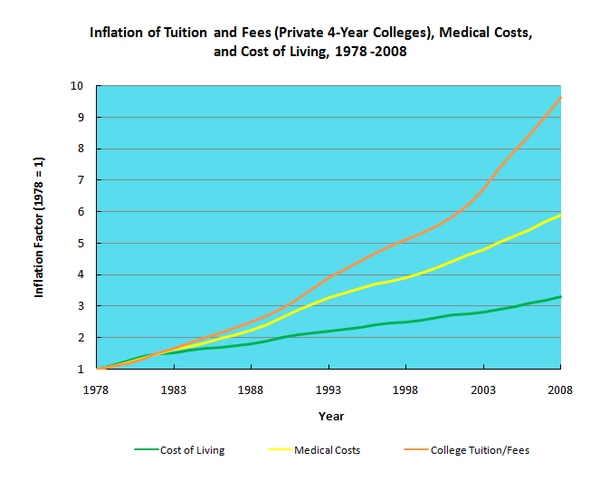
The above graph (CollegeBoard) shows that increase in college tuition fee has far exceeded inflation rates in the US.  Considering most colleges, at least, the state universities are non-profit institutions, what could be the reason behind this sharp increase in tuition fees?

There are several theories floating in the academic circles, including, a potential "higher education bubble", or a decrease in government appropriation into the education system, mismanagement of endowments, and lack of consumer protection.  Personally, I posit that the federal students loans program has played a large role in not only raising college tuition, but also herding our top engineering and science students into the corporate and banking sector.

Since the federal government started providing low interest student loans to make education more affordable, this increased the market for higher education, allowing universities and colleges to hike up their tuition fees by recognizing that now more students had access to money to afford these higher fees.  Unfortunately, this system led to students graduating college with massive amounts of debt, and instead of pursuing vocations they were really interested in, were forced into majoring in subjects that would provide the maximum employment opportunity upon graduation.  This phenomenon caused a large increase in students pursuing subjects like economics and finance, and of course, the ubiquitous MBA.

Why does an MBA cost so much when one can learn pretty much all the material through Khan Academy and a library card (read Good Will Hunting) in six months.  Well, first, it provides you with a stamp of legitimacy - we live in a paradigm of label-able education.  Although in my opinion, knowledge and literacy almost has nothing to do with being educated.  I have found many "MBAs" pretentious and arrogant [3].  Even worse is the increasing trend of engineers pursuing MBAs to take up corporate management positions, ridding the world of clever engineers and replacing them with greed infused suits.  Second, this "need" to do an MBA has made the demand for the degree sky rocket allowing schools to charge fees which in any other profession would be called highway robbery...

So, the banking system, through their loans, allows colleges to increase their tuition, encumbering students with massive loans so they end up taking jobs with the said banks after they graduate... an unusually unhealthy system.  Can we break down this system?  Should the US federal government stop giving out low interest loans?  Should education be completely free market?  Doesn't that skew the level playing field then?  Should governments cap tuition fees like in the UK, or make colleges free like in Europe?  Whoa, that sounds like socialism...  I don't have the answers, but it's something to think about.

Addendum: 24 September 2014
Here is John Oliver's ("Last Week Tonight with John Oliver") brilliant and hilarious take on the Student Debt Crisis, from an angle I had never considered before.  Consider meself suitably humbled.


[1] Understand that Investment Banks do not actually invest in ideas... they invest in existing businesses for vast commissions.  While IBs may also be adding to the real economy, they do not necessarily push for innovation.  An IBs primary goals are M&A, financing solutions, corporate consulting and risk management, and investment solutions.  This is vastly different from VCs.  Similarly, merchant, corporate and commercial banks do also invest into new businesses but deal with vast capital and not particularly with new ideas.

[2] Let us, for the sake of argument, ignore the manner in which banks create fictitious wealth through complex financial instruments that serve no purpose but to sponsor bonus checks.

[3] I remember a person once tried to get me to buy into an Amway type pyramid scheme, and when I painstakingly pointed out all the inherent fallacies in his arguments, he asked me with a sneer, "Do you have an MBA?"  "No", I had replied.  "Well I do, and I'm telling you this works."  Case closed.

Monday, June 09, 2014

The Problem With Patriotism

I recently read Ramchandra Guha's article in HT, entitled, "Excessive love of one’s state is less harmful than that of one’s country", which talks about regional pride in literature and culture.  This debate was sparked by Guha's comparison of Kannada polymath Shivarama Karanth with Bengali literary god, Rabindranath Tagore.  I am not interested in this argument.  Personally, I believe, Bengali intellectualism and literary elitism is in decline and like the British, we are living off by selling the family silver (so to speak).  

No, what I am more interested in is exploring the idea of patriotism.  Being blindly loyal to some arbitrary division of land or world view, is an idea so abstract that I can't really fathom the need or requirement for it.  To me, patriotism, for country, religion, or an idea, if anything, is detrimental to the fabric of tolerant societies and a marker for regression.  In Tagore's poem, Where the Mind is Without Fear, he writes, and I paraphrase, "...let me awake in a world that is not broken up by narrow domestic walls" - a sentiment that resonates with me.

When I was backpacking through Europe several years ago, the political pub talk revolved around the wisdom of including the ten new countries to the European Union.  What was most striking about these conversations, and we see in the political set up of Europe today, is the rise of right wing sentiments in Western Europe.  In the recent EU elections, the anti-EU parties enjoyed a significant bump as outlined by this Telegraph article in May.

In my limited opinion, this "right-wing swing" is essentially a form of xenophobia in disguise.  The EU, I always felt, was the natural direction of humanity's future, a step towards global political and social unification, but it seems our basic need for a "us and them" framework is too overwhelming.  Give us aliens to fight and we're going to come together, otherwise we're going to find our own aliens... in the case of Europe, that's everyone who isn't, well, Western European.

Part of this "us and them" mentality is buried under the guise of patriotism.  "Self-interest" and "self-preservation" is tantamount to patriotism, and it is this kind of backward thinking that negates the momentum towards a politically and socially cohesive world.

In the context of India and Pakistan, patriotism rears its head when we're playing a cricket match or we're at war, and somehow brings out the worst in our generalizations about each other.  I've met many Pakistanis in my life and I've enjoyed their company very much.  Of course, that in itself is a generalization, and probably holds true for the 1 percent liberally educated urban youth I have interacted with.  My point is that we have no right to use the label of patriotism for actions and words that dehumanize people in a country, idea, or religion that is not ours.  Patriotism, like the practice of religion should be private and personal.  Rather than slap on some face paint when there is a cricket match, if we were really patriotic, we would treat our fellow citizens with respect, and not urinate by the side of the road or treat the country like shit.

I am aware of the argument that the need for barriers is seeded in animal instinct.  Chimpanzees, wolves and other animals that live in some form of social structure, display tendencies of divisiveness; acting in the interest of the pack or herd against other packs or herds.  However, considering we have put a human on the moon, is it really a legitimate argument to claim animal instinct as the basis for the most divisive notion we have in society?  Can we not say that, we, as a species, are better than wolves? [1]

All patriotism has really done is reinforce the imaginary boundaries that separate groups of people, who in all likelihood, under other circumstances could get along.  I'm not trying to demean the idea of patriotism, just the way we practice it today [2].

[1] The same applies to religion.
[2] I have nothing against wolves per se.

Sunday, September 15, 2013

History and Perspective - Cool Stuff!

Live Leak hosted a fantastic video of the changing political geography of Europe and Asian Minor from 1000 AD to the present day.  Fascinating stuff if you like history and geography and politics.  Ideally I would have liked a time clock to go with the video too, but it is about 5 years for every 1 second.  Original source.

The blog, "Wait But Why", posted another fascinating graphic about time and perspective.  Think of it as the Total Perception Vortex on paper!
Have a look - source.

Lastly, for an epic burn, have a look at the Kickstart submission about Obama's duplicitous foreign policies.

Have a good weekend!

Wednesday, September 04, 2013

Oh Syria... Why You Vex Me?

Forget the memes, forget John McCain playing poker on his phone during a Senate hearing on Syria and tweeting ":( I lost", forget Miley Cyrus twerking (hey Spellcheck, this is a real word now), forget Obama's Nobel Prize for Peace... what I want to know is, is the war going to hurt export of hummus?  Because I love hummus... Let's get serious people.


Photo credit: Tumblr

Wednesday, July 10, 2013

Whatcha Readin'?

An interesting article about the state of micro-finance in Nepal.

WHO starts a panel to estimate the cost of climate change on health-care.

Friday, June 07, 2013

Diamonds Are Forever... But Is Narendra Modi?

The power of marketing and manipulation.  The power to control and contort prices.  Monopoly over supply.  That is how De Beers has maintained the largest bubble in the history of modern consumerism.  Truly spectacular.  Here have a read.

Call me conspiratorial, but I think there is a striking similarity between this De Beer's scam, and Narendra Modi's political prowess.  The success of both ride on the same things - superb marketing and public relations campaign, ride on the general stupidity of the mass populace who believe, if it's on the internet it must be true - you know who they are; and   creating massive artificial demand for something that has no intrinsic value.  A bit like how we give Clinton the credit for the glory days of the 90s stock market boom, which was nothing more than the seeds of the Dotcom bubble.  Here again we are facing a similar story.  

I have nothing against Narendra Modi per se, I just don't understand why we are all caught up in the hype when it is exactly that - an unsustainable, and nationally impractical hype.  Not to mention he slaughtered all those people...

Friday, May 17, 2013

Some Get Away...

There are some stalwarts that get away with plagiarism.  Bollywood is a classic example.  But the one that always gets on my nerves for some reason is that brilliant fraud Anu Malik.  There are many others like Kumar Sanu et al, but Anuji, as he is reverently called, is in a class of his own.

Monday, May 13, 2013

DFW FTW! Also Starring Randy Pausch

David Foster Wallace is one of my favorite authors.  Perhaps even one of my favorite philosophers or thought leaders, and it is ironic that I found so much solace in the words of a man so deeply disturbed that he could not find it bearable to live.

I wanted to share DFW commencement speech at Kenyon College in 2005.

It left a profound impact on my when I first heard it after DFW passed away in 2008, the year I graduated from college.

Recently, a group called "The Glossary" took an excerpt from the speech, a section called, "This is Water" and made a striking video.

Also, in the vein of great speeches is Randy Pausch's "The Last Lecture" - which was truly a roller coaster ride of sorrow, inspiration, and joy.  

Enjoy, and be inspired.

Saturday, May 11, 2013

A Curious Mind

Happy birthday Professor Richard P. Feynman.  Google might have forgotten you again, but the world hasn't.

The 95th birthday of one of the greatest scientific minds of the twentieth century.

Leonard Susskind's talk at TEDxCaltech celebrating Feynman.

If you want to know more about this remarkable man, pick up a copy of "Surely, You Must Be Joking Mr. Feynman".

Friday, April 19, 2013

What Grinds My Gears

There are things that rile me up.  Some of them I can talk about, others are best left unsaid.  Everyday the news depresses me.  Heroes fall from grace and vile people are put on pedestals as a beacon of progress.
Narendra Modi - really, this is the man we now consider as a hero?  Are we reverting back to a time when it was acceptable to trod on the lives of others for reform?  Have we learnt nothing from our past.  Are we really simply ignorant or do we choose to wear blinders from the truth? 
I was shocked and ashamed to hear that there are some people who treat the Godhra Riot, not as a blemish on this nation's soul, but as a small matter that needs to be overlooked in the name of economic progress.  The debauchery and seething hate fostered and encouraged by the Modi administration is nothing short of horrific and should never be forgotten.  At the risk of evoking Godwin's Law, let me state that the greatest autocrats and despots of our time swayed the people with the promise of economic reform and progress.  When your ideology states: "Muslims, they don't deserve to live!"  I shudder if our fate is to have this man as the prime minister of India.
Enough about that ass (do I risk getting arrested now?).
Then we have the two clowns Lance Armstrong and Oscar Pistorius, way to further ruin the integrity of sport for me.  I was already reeling from the football match fixing scandal...

And In Other News

In a week where a lot of things have happened, the Boston Marathon Bombings have captured the public's eye - with no small measure of help from the 24x7 news media.  A lot has been written about it already without me adding to the stir.  What I do want to comment on is how conveniently we shroud ourselves in ignorance against violence in some cases, and storm with rage in some cases.  We very subjectively choose to react to tragedy.

The Boston bomb is not the first explosion in the world this year, month, week, or even day, so why has it occupied every news station for the past two days?  Not only do we still not know much about it, the news has served no other purpose than to precipitate a plethora of speculation, fear, and hate mongering.  Yes, this was the first attack on US soil since 9/11, more than a decade ago.  I understand.  It's not a question of sympathy or condolence, please, weep; but also weep for the thousands of soldiers, civilians, women, children being torn apart in Iraq, Afghanistan, Pakistan, India and about another hundred places in the world.  By the US's own maxim of every life is sacred, it seems ironic, that a Boston life is worth more than others...  

I can barely write or put thoughts on paper, so I will let Glenn Greenwald of the Guardian UK do it for me. 

It appears that we find it acceptable when there is death and destruction in a setting of predisposed violence (read: war).  The US government changed the status of people arrested under the Patriot Act and shipped off to Gitmo as "enemy combatants" to create the aura of war (and of course to circumvent the Geneva Convention).  When injustice and violence takes place in an act of war, it becomes perfectly acceptable to us, or rather we don't even discern it as death, but as a natural sequence of events in a war zone.  At some primal level we know that violence in some cases is not only perfectly acceptable, it is a necessity.  For all our iPhones and spaceships, we are essentially still primitive when it comes to our basic instincts.  Fifty thousand year old habits can hardly be erased by a hundred years of technological progress.  

And there is also the head in the sand attitude with violence we feel righteous.  As Greenwald writes, booby trapping bodies is evil, but drone attacks and deliberate targeting of civilian populations[1] are, well, necessary - we are fighting terrorism after all.  Where is the outrage there?  

[1] When Julian Assange first hacked into US MILNET in 1989, a part of the evidence he uncovered was that the attack on civilian centers were a strategic military target approved by the US government.  Not much has changed in the Second Gulf War.

Students are the Priority

(Fiduciary Disclaimer: This is a joke!)

I did an impromptu survey in my economics class about what they had to complain about their educational experience.  In my own perverse way I was trying to assess the way students prioritize their world and their learning environment.  I am listing these in the order they were suggested.  
  1. No vending machines
  2. The desks were too small
  3. The wall colors were not soothing
  4. The toilets did not have toilet paper (this is due to vandalism)
  5. The toilet flushes rarely work
  6. Alternative toilet paper (not sure what this means)
  7. No dedicated pen store on campus (no wonder my students come to class without pens)
  8. A 4G wi-fi system (not sure what this means either)
  9. Food
  10. No swimming pool
  11. No movie theater
  12. No smoking lounge
  13. No hookah bar
  14. No bar
  15. No proper pool table in the students lounge (yes, we have a pool table in the student lounge, but apparently it's not proper)
  16. No shooting range (so we want guns on campus?  Make up your minds)
  17. No go-karting circuit
  18. No cotton candy machine in the Gymkhana (KIS speak for tuck shop)
  19. No polo grounds (no horses for that matter either, or did they not realize that?)
  20. No golf course (yes, mountain top golf courses are all the rage these days)
  21. No paintball course (more advocacy for guns on campus, strange)
  22. Teachers (the note was "teachers who are both good and evil" - I wonder where that leaves me?)
  23. No good concerts like Tiesto on campus
  24. Better and more attractive notebooks
  25. New textbooks (the present ones are almost a year old)
  26. No Jacuzzi (for the SS Dept please!
  27. A better Student Council (I suggested, perhaps better students as well)
  28. Everything

I'm surprised no one mentioned that we don't have a Space Program idea... 

Bazinga!

Wednesday, April 17, 2013

Pop the Pill and Party

A brilliant lecture by James Robert Brown outlining how pharmaceutical companies have stagnated medical research and are detrimental to innovation.

Here is an article corroborating his insight, that although, the popular anti-depressant Prozac is essentially nothing more than a placebo, except in the most extreme cases, its and other drugs in same class have continued to be prescribed by doctors around the world.

Medical research and information is so tightly controlled by pharmaceutical companies that our rate of innovation for every dollar spent on research has actually decreased - a sort of a reverse Moore's Law, aptly called Eroom's Law.  And we call it progress...

The same extension can be applied to oil companies researching alternative technologies or tobacco companies researching the effects of cigarettes or coal companies debunking global warming.  Scientific research has been bought, its authenticity and sacrosanctness pillaged, and we are none the wiser.  

Face it ladies and gentlemen, the "Free Market" has failed Science, we should accept it.

Monday, April 08, 2013

Know Thyself, Challenge Thyself

I'm becoming increasingly attracted to “confluential” studies – integrating different fields to arrive at universal solutions for the development of humans as a species.  There needs to be a change in the common social belief - a zeitgeist if you will.  A social, economic, and scientific revolution is overdue and I hope it happens in my lifetime.


A friend recently told me about how more and more people are becoming aware of injustice.  Young people and students want to do something about it, but the options are currently limited.  While that is true, in my opinion, the movement has not reached critical mass to precipitate a change.  We still live in a world where the top 300 people have the wealth equivalent to the bottom 3 billion.  Take a moment and fathom that staggering statistic.  How can we hope to overturn the status quo, particularly politically and economically in such a toxic environment?  And science, the forbearer of our future, is servile to politics, economics, and the social zeitgeist.


Humans as a species prefer having authority figures reign over them.  It is the Savannah spirit of having herd leaders.  We need someone to take the blame.  It is never our fault.  No soldier is ever responsible for war… they were simply following orders.  Consider the Stanford Prison Experiment, or the rise of authoritarian governments like Mao, Mussolini, Hitler, Pol Pot, Kim Jong Un… the list is endless.  Why do we allow ourselves to be subjugated?  Perhaps it is our inherent animal nature to have a leader to follow – to take orders.  The ones that break out of this mold become the subjugators.  We rarely question leadership, and when we do, we approach it with chaos, indiscipline, and in a morally ambiguous manner.

So, where does that leave us?

Well, for my part I hope to make my students economic revolutionaries – to have the ability to think for themselves, develop a sense of social responsibility and question what most of us around take for granted.  Challenge the zeitgeist.  That doesn’t mean they should become anarchist, or ape around in the classroom pretending to be challenging authority.  It is unfortunate most students are too immature to truly perceive what I mean by challenging conformity.  It means to allow oneself to become a free thinker - to question life in the Socratic sense. 

Recently, I had a conversation with a student about the role of women in sport and at the end of the conversation she said, “Wow, I’ve never even thought of that”.  And therein lies the rub.  We have stopped thinking because we are surrounded by different machinations aimed at keeping our youth distracted and absorbed in intellectually mundane activities.

Not to mention a majority of privileged students squander their educational opportunity – the ability to think and question and challenge the social norms – and instead feel satisfied festering in a pool of their intellectual poverty and distractions.  It is sad how in some of the best schools in the world has a culture that belittles intelligence than celebrating it.  They are happy, following in the footsteps of their silver spoon and entitled lives.  It is quite saddening and pathetic.

However, it is our responsibility as teachers to create the watershed moment in our students thinking.  Teachers and educators have enormous influence on how we think and perceive the world.  Sometimes it scares me how much power and influence educators really have – much more than any CEO.  We are shaping the mindset and vision of an entire generation of leaders and the effects of this influence is going to resonate for years to come. 

Challenging the socially accepted norms is the foundation and hallmark of innovation.  We must be taught to think and question.  But that is what is lacking at most places, and in most teachers, and consequently in most students.  Let’s hope that changes.

An interesting commentary on the apathy and indifference of India's elite.

Monday, March 25, 2013

The Troika verses Cyprus

Cyprus, the tiny Mediterranean island nation of 800,000 people (20 times less than the population of Delhi), managed to evade bankruptcy and exclusion from the Euro Zone by successfully negotiating a deal with The Troika - the three largest lenders and debtors in Europe - The European Central Bank (ECB), The European Commission (EC), and The International Monetary Fund (IMF).  

However, rejoice not yet, for this $13 billion bailout comes at a massive price.  Never mind that Cyprus' debt is now going to be 100% of its GDP, but in order to avail of this $13 billion loan, the Cypriot government has to raise about $5 billion on their own (AP).  But how is a nation, whose GDP is about $20 billion, supposed to raise 25% of their GDP in six months?    Simple, they are going to take away bank deposits over $100,000 from Cyprus' second largest bank - Laiki.  Like the US, bank deposits in tax-haven Cyprus are insured by the government for up to $100,000, anything above that is non-insured deposits, which the Cyprus Government plans to use as part of their $5 billion "fund raiser".  The legality of such an action is still under discussion, but if it is sanctioned, people may lose up to 40% of their deposits at Laiki.  Most of this money actually belong to foreign depositors, mainly Russians, who use Cyprus as a tax haven.  

Laiki is going to be split into a "good" bank and a "bad" bank.  The good bank with its insured deposits will merge with Bank of Cyprus, the largest bank in Cyprus, and the "bad bank" with all its toxic and uninsured assets will be dissolved!  Not to mention all deposits in Bank of Cyprus over $100,000 is going to be frozen indefinitely and there is a withdrawal limit of $100 per day to stop a "run on the banks".  A very bold move indeed.

Austerity measures have already bludgeoned the economy with everyone from contract teachers to businesses taking heavy hits, and now the dissolution of private bank funds is only going to make the public more enraged.  Cyprus, once one of the most economically sound countries in the world with a net median income of about $30,000 per year (CIA), is now tottering on the brink of economic extinction.  How did this happen?

Again, it all traces back to the US sub-prime mortgage disaster of 2007.  Truly when the US sneezes, the whole world catches a cold.  Cyprus, with its low tax rates is a haven for foreign, particularly Russian deposits. This created a bloated financial sector eight times its GDP!  Like Iceland, the Cypriot financial sector had made a series of poor investments, including buying Greek bonds as a precursor to this crisis.  Coupled with slowdown in the tourist and shipping sector due to the global economic meltdown, the Cypriot economy was unable to recover to its pre-2009 fundamentals.  The massive size of the banking system also prevented the government to raise enough liquidity domestically to bail out its banking system.  

For the past year (2012), Cyprus has relied on an emergency $2 billion dollar loan from Russia, Cyprus' closest partner; but a refusal on Russia's part to extend the loan resulted in Cyprus approaching the EU with their begging bowl.

Perhaps Cyprus has managed to evade bankruptcy and exclusion from the Euro zone with this bailout, but whether Cyprus' restructuring will be a Renascence moment is difficult to gauge.   But, a good time to buy property in Cyprus I reckon.

For further reading.

Sources: Associated Press, Reuters, CIA Fact Book, BBC.

Sunday, March 24, 2013

We Are All Slaves

"Students who acquire large debts putting themselves through school are unlikely to think about changing society.  When you trap people in a system of debt they can't afford the time to think.  Tuition fee increases are a disciplinary technique, and by the time students graduate, they are not only loaded with debt, but have also internalized the disciplinarian culture.  This makes them efficient components of the consumer economy."
~ Noam Chomsky

And that is just the tip of the iceberg... 

Thursday, March 21, 2013

India Declares War on Italy!

Now that I have your attention, let me assure you that India is not actually declaring war on Italy.  Although the question of whether we should is a legitimate concern in the minds of several people.

For the unaware, here is the quick recap.  In 2012 two Italian marines protecting an Italian merchant ship from Captain Jack Sparrow, shot two innocent Indian fisherman off the coast of Kerela.  The Supreme Court of India ruled that India had jurisdiction in the case and placed the marines under arrest.  In December, at the behest of the Italian government, and the promise that the marines would return to India to stand trial, the two marines were sent home to vote in the general elections and spend Christmas with their families.  But, here's the kicker.  The marines didn't come back.  

The Italian government is now contesting the Supreme Court ruling on the grounds that the shooting happened in International waters which is beyond the Indian government's jurisdiction.  Call it bad faith or simply lying, the Indian government was stunned at the turn of events, especially in the light of recent events involving in a billion dollar corruption scam with the Anglo-Italian helicopter manufacturer AugustaWestland.

So what does our beloved UPA government led by, and here's where the irony comes in, led by an Italian (read: Sonia Gandhi), do?  Simple, bar the Italian ambassador from leaving the country.  Meanwhile, the two marines are given a hero's welcome! Cool, so what happens now?  We await with bated breath.  Good thing Italy doesn't have nuclear weapons, eh?  

Perhaps on the good news... which we have so little of these days, India was not ranked as the rudest country in the world to tourists!  You may not agree with the ranking, but makes interesting reading.  Ironic that the Americans are writing an article on rudeness!

Tuesday, March 19, 2013

The Three Wise Friends

My friends came visiting.  Three wise ones followed the Ghat to my humble little abode.  They brought in some welcome laughs and reminiscent winds, but most importantly they brought gifts!

Finally my new LP player and LPs are here.  Old friends like New Order, Depeche Mode, and the Psychedelic Furs... truly, my bosom for a pillow is on the 45.  If you didn't get that pop culture reference, then too bad.

Photo courtesy: Dilanie Devadoss.  Thanks.

Also in the delivery was a super cool green laser.  The geek liveth again.

Thanks SS, Megha, and Amit!  You'll are the best.  
Honorable mention to Maggie C!  Your thanks is DM concert tour this fall.

How to Save The Economy

Mssrs. David Mitchell and Robert Webb show us how the government decides to bring the economy back on track.  What renowned Econometricians do behind closed doors.