Tuesday, November 22, 2016

Butter Chicken (Maybe)

Recipe for my experimental butter chicken.  Recipe is for 2 pounds of chicken, usually serves about 5 people.  Adjust ratios (or not) for different measures.  Use fresh ingredients when you can.  Will take about an hour and a bit if you're efficient.

Ingredients:

  • Chicken thigh filet cut into small pieces (works with drumsticks and bone-in just as well; try not to use breast though; gets too dry)
  • 2 tablespoons ginger paste
  • 2 tablespoons garlic paste
  • 1.5 tablespoons of whole cumin seeds
  • 1 tablespoon red chili powder/cayenne pepper (adjust according to the heat you want)
  • 2 tablespoons coriander powder
  • 2 tablespoons salt
  • 2 tablespoons paprika for color 
  • 2 tablespoons of fenugreek powder or crushed dried fenugreek
  • 1 teaspoon garam masala
  • A fistful of unsalted cashew nuts (salted works just as well, just adjust for it)
  • 3 green chilies (chopped - again adjust for desired heat)
  • 2 onions (medium; chopped; red or white work just as well)
  • 3 tomatoes (medium; chopped)
  • 1 stick of unsalted butter (use real butter, non of that margarine nonsense)
  • A fistful of chopped cilantro for garnishing
  • Oil; water; heavy cream; ketchup

Marinate the chicken with half the garlic and ginger paste, red chili powder, coriander, and salt and set aside for a couple of hours if you can.  If not, no worries.  

Heat the oil in a large skillet, preferably stainless steel instead of non-stick.  When the oil is hot, flash fry the chicken.  Fry till chicken is "browned" (which is weird, because it turns white - *insert your own politically incorrect joke here*).  Don't worry if the marinate sticks to the pan.  Remove the chicken and set aside.  

In the same pan, add the cumin seeds, the onions, green chilies, the rest of the ginger and garlic paste, cashew nuts, red chili powder, coriander, fenugreek, and tomatoes - I prefer to do it in this order.  Then add the water and slowly scrape the browned masala from the bottom of the pan.  Cover, reduce the heat and let it come to boil.  Let it slow cook for an arbitrary amount of time.

Pour the mixture into a blender (Vitamix ftw).  If you don't have a Vitamix let the mixture cool a bit so you don't blow up your blender.  Blend into a fine paste or liquefy depending on the texture you want.

In the same pan, throw in the stick of butter, let it melt and the pan get hot.  Throw in any water that might have oozed out of the chicken that was sitting on the sidelines.  Add the blended mixture.  Add some ketchup (depending on how tangy you want it to be), add some heavy cream (depending on how creamy you want it to be), bring to a boil and then toss in the chicken, add the garam masala, reduce heat, cover and let it cook for an arbitrary amount of time till the chicken is fully cooked (I would say 10-15 minutes should suffice).  

Take off stove.  Garnish with some more heavy cream and the chopped cilantro.  Let it sit for a few minutes and serve.  Voila!  

Should look something like this

Wednesday, November 09, 2016

The Weak Suffer What They Must For the Greater Good?

By allowing people to declare their opinion on any event, Facebook has made it difficult to sway people's arguments using logic (or evidence), since we are less prone to change our mind if we have to redact our opinion or admit being wrong.  Which is why I try not to engage in debates on social media.  Nevertheless, perhaps this will take my mind off Trump.  This is by no means a research paper but all self selective citations are at the end of the post.

On a morning when Donald Trump is the new President-elect in America, I am hit with my friends and colleagues rejoicing in NaMo's demonetization plan to combat 'black' money, calling it "brave, bold, decisive, incisive" and other superlatives.  However, this issue is not, if you will pardon the pun, as black and white as one might initially think.

For the uninitiated, this is what happened.  On Nov 8, at 8 pm, Indian Prime Minister Narendra Modi announced that effective that moment, all 500 and 1000 denomination currency notes will no longer be legal tender.  He explained that this decision will help curb black money and counterfeiting.  You can read a detailed account of what happened in this Reserve Bank of India press release.

Who would not be excited at the prospect of a "bold and decisive" government policy to curb black money, eh?  Certainly the neoliberals sitting in their ivory towers on Facebook love this idea. While the perceived intention of the policy is along the right lines, there are some issues worth considering here.

Modi's sudden call to demonetize, seems much like his earlier schemes like Jan Dhan Yojana... a jumla.  However, while the opening of millions of ‘zero balance’ bank accounts under the Jan Dhan Yojana was a harmless gimmick, the ill-conceived monetary decision this time will inflict costs on the public.

First, nobody knows how much black money is actually in cash, and how much in other tangibles (Hindustan Times).  The 2012 report on the 1978 Janata Dal/Morarji Desai demonetization found that the majority of black money is in benami land, gold, and off-shore accounts.  It did little to combat black money in the "long run". I will admit that there are stronger tracking systems in place now, but there are also knew avenues of laundering (Indian Express).  The big fish have long devised much more sophisticated ways of stashing their money.  The current demonetization is unlikely to touch anything more than a fraction of the present stock of black money in India (HT).

This is what the policy has done so far: In Gujarat, sale of gold increased on 9 November with an increased 20 to 30% premium as people bought gold in exchange of their unaccounted cash.  The Hindu reported that such transactions have been made back dated.  The targets for this policy is already gaming the system, and the working class that barely have any money, let alone black money are the ones paying the toll  (The Hindu).  The liberal elite do not seem to understand this, calling it "a minor inconvenience that will be over in a week".  The worst statement I have read is a comment: "We have to take care of our domestic helps, that's our responsibility."

Having said that, there is definitely an argument to be made for this policy to lower corruption at the mid-level.  My friend Tanmay Shukla made an argument, which I am going to paraphrase:

When folks with black money buy a house in India, to avoid stamp duty people pay half in cash right?  Not jewelry or bullion or other properties.  When a bureaucrat pays another to get a promotion he has to use cash to avoid a second round of negotiations over the value of what he is offering as bribe.  Politicians, whose main reason for being corrupt is that they need a lot of funds, and need to make a lot of payments to stay in power.  So disrupting the currency supply should disrupt corruption.  We are not sure why it did not work in 1978 but casual observation goes against this idea that black money is not stored in cash.  However, one problem with this initiative is that it disrupts the flow and not stock of black money.  It can temporarily cripple people and make them fearful of being corrupt, but then Modi has to take advantage of their handicap to force a more permanent change.  We don't know what he is up to behind the scenes so it might be worthwhile to wait and watch.  Then again it might not.

Second, the demand for Aadhar and PAN cards while exchanging these notes at banks or the post office is an affront to the poor - most of whom are without these documents or the cultural capital to haggle with the institutions demanding them.  According to UDAI statistics, as on Nov 2016 about 80% of the total population have an AADHAR (1.07 billion issued) identification card.  Not including children, that leaves about 200 million people with no way to work around this policy. (UDAI stats shows more than 100% issuance rates for some states, so I would take their numbers with a grain of salt - this is not the first time the administration has inflated numbers, remember the new GDP estimators?)

Moreover, getting an AADHAR card doesn't happen overnight, particularly in remote places - what will they do in the meantime?  I think it is unfair to justify a "long term solution" with such a massive cost, which can have enormous long-term consequences.  Having an attitude that the poor can deal with this minor inconvenience for a couple of days, is naive and high-handed.  The government can do issue some studies of the expected cost to the economy and tax payer through demonetization and re-issuance, and some evidence to support that the black money recovered or destroyed will significantly trump that, otherwise it is simply not justified.  I want to see the mathematical logic of why and how this will work, especially since it did not in 1978.  I can't believe I am actually siding with Mamata Banerjee and Sitaram Yechury on this issue.

The government pushing for demonetization and asking the Reserve Bank to tag along also brings to question the separation of powers between the executive and the central bank.  If this excerpt from former RBI Chair Raghuram Rajan, is anything to go by, I do not think he would have supported it.
"There are alternatives to fighting..."
The decision has created chaos (Reuters), ordinary folks who work on daily wages are stuck with worthless cash and cannot buy basic supplies.  Certain shops are charging a 4:5 ratio to convert cash because banks and ATMs are shut - the BSE SENSEX tanked 6.3% and is forecast to lose more as the economy comes to a grinding halt over the next few days.  It is all good if you have a card and shop at Metro Mart, but it is a difficult disaster to survive for a substantial chunk of the country - the informal economy, which contributes about 20% to the GDP (Guardian).

Starting the 11th of November banks and post offices will allow people to convert their old bills for smaller denominations, but there is also a limit to cash conversion - Rs. 4000 per day.  The cost to banks and folks going to the bank to convert their money everyday will be stressful and hurt business.

Markets in Calcutta were closed today as the majority with purchasing power have very little low denomination cash on hand.  ATMs and banks are closed till the 11th - so what do we do in the meantime?  People are panicking because not everyone has plastic, in fact, the majority live on daily wages, so if you're sitting on Rs. 1,500 in 500 rupee notes and no one is accepting them and you have to change it in a bank and you don't have an ID - you do what anyone else would do - you panic.

Additionally let's not forget the Muslim population who do not use traditional banking systems - they are left out in the cold.

Finally, the skeptic methinks this is a ploy to reduce cash circulation as the UP elections are coming up to prevent ballot capturing.  The idea of issuing 2000 rupee notes will simply reset the system, so how is this a long term solution?  (Economic Times)

The arguments that this policy will do wonders for promoting e-commerce as well has the whole "India Shining" issue written all over it.  As for the contribution of this move in combating terrorism, it is a red herring.  The role of opaque instruments like Participatory Notes, used by FIIs operating in the Indian stock market, are more relevant for financing terrorism than Indian currency notes of high denomination (HT).  However, there is an argument to be made for the short-term increase in the value of the Rupee as there will be a heavy liability lift on RBI's books.

As Prosenjit Bose writes: 

"The real problems ailing the Indian economy lie elsewhere. The amount of stressed loans in the Indian banking system has crossed a whopping Rs. 9 lakh crore, a bulk of which is owed by domestic corporations to the public sector banks, causing a huge debt overhang.  Despite doubtful claims of fast economic growth, revenue mobilization has not shown any signs of improvement and consequently, re-distributive policies have been rolled back.

Under the Modi regime, substantive measures to promote investments, economic growth, revenues and welfare expenditure have been supplanted by gimmicks, PR spins and a brazen pursuit of select corporate interests. The latest instance of a conflict of interest lies in today’s full page newspaper advertisements by an online payment service provider congratulating the Prime Minister for the demonetization announcement."

It seems that the argument is that it is okay for a government to destroy the wealth of several hard working and honest citizens some of whom are in the poorest strata of society because they have no recourse (I include myself in this as I am sitting on cash here in the US and in my apartment in Calcutta that will essentially go to waste) @ 11,000 crore rupees cost to the tax payers to print new money (not including all the legitimate cash that will be destroyed and loss to business and waste of time and energy), create chaos and confusion, slow down the economy, disrupt regular business, not catch any of the really big fish because they have land, gold, and offshore accounts, make no arrests, and reset the black money counter in February after the elections?

Oh, and by the way, those Whatsapp messages your aunt sent you about nano GPS trackers in the new 2000 rupee notes is a hoax.

So what are the alternatives to this sensationalist stunt that hurts the working population instead of actually hitting the real criminals?  For starters, let us get a better understanding of why people engage in the black money economy.  Admittedly, the initiatives by the government to renegotiate the double taxation agreements with Cyprus and Switzerland - great idea.  Convictions based on Panama Papers - super.  Tougher auditing measures - great.  All of these target the top 1% who have about 74% of India's documented and undocumented wealth.  Can we give the poor some respite for a change and hit the ones who really need a punch in the bracket?

16 Nov 2016 Edit: The PM has asked for patience till Dec 30 - I will wait, I wonder if the poor can...

Resources and articles:


Friday, November 04, 2016

Adventures in Rock: Part 1

Part 1: Opening Doors in High School

"There are things known, and things unknown, and in between are the doors" 
~ Ray Manzarek [1] 

Writing about something as subjective as music is a curious and precarious task.  So instead of attempting to create an objective list, let me talk about my personal journey and experiences in discovering rock, naive and sparse, and at times embarrassing, it may be.

Govinda is awesome and I will not apologize for it.
Born in a musically devoid home and educated in a missionary elementary school, by the time I went to high school, my knowledge, exposure, and understanding of music was accidental at best, and abysmally tasteless at worst.  My early years at Doon reverberates with the memory of the common room stereo blaring a combination of David Dhawan's Govinda "Number 1" soundtracks, some version of Now That's What I Call Music, and techno - which is what all the cool kids were listening. At one point, I could sing most of the Backstreet Boys and Britney Spears discography.  Rarely did I hear anything else, particularly since we had no access to the internet or international radio stations in 1998.  MTV and Channel V, though available, had limited diversity and we did not get a TV in the dormitory till 2001, and probably only tuned in to MTV "Most Wanted" for Shenaz Treasurywala.

One of reasons 90s MTV was fun
All that changed in tenth grade.  My friends and I sneaked into the Oberoi House dormitory common room to play table tennis at 7 in the morning on a Sunday morning only to find a senior, Abhishek Singhania, listening to music at a near muted volume.  We spent the morning in quiet harmony, Singhania listening to Simon and Garfunkel and Metallica (an odd pair) and me playing table tennis.  What stayed with me from that morning was a realization of how little I knew about the world of music.
"Like a Bridge Over Troubled Waters" ~ S&G
That summer I picked up a G3: Live in Concert audio cassette from the local Archies store in Dehra Dun on a whim.  I quite enjoyed listening to the distorted guitar sounds of John Petrucci (I didn't know Dream Theater then), Eric Johnson, Steve Vai, and Joe Satriani.  Admittedly, part of the appeal was hipster-ish.  Yes, I also see the irony.  Stemming from G3, I dabbled in picking up some random "rock" albums - Now That's What I Call Progressive, which had no Genesis, King Crimson, Rush, or Yes; Best of Alternative - which introduced me to Puddle of Mudd, Five For Fighting, and POD, Linkin Park, and Limp Bizkit - dark days...

Not pictured: Steve Morse (Deep Purple), John Petrucci (Dream Theater), Yngwie Malmsteen,
Robert Fripp (King Crimson)...
My eleventh grade exchange program to Wanganui Collegiate School in New Zealand was the first time I found a music mentor.  Harvey, who was the house captain of my dorm aptly also named Harvey, was one of the most charismatic people I have met, and quite the ladies man (as much as a high school senior can be).  Harvey literally opened the doors to his music (he had a nice CD cabinet) and for the first time I was introduced to The Doors (again, I had not seen the Oliver Stone film at this point).  Surrounding The Doors were assorted windows to newer scenes like Incubus, Weezer, Pennywise, and the Dave Matthews Band.  But "The Doors"... man.  The extended jam  on "Light My Fire", "Soul Kitchen", "Peace Frog", and of course, "Roadhouse Blues"... I did not smoke weed but Morrison et al made me feel like I understood what it must be like.  Their 1967 eponymous debut album The Doors would be a good gateway drug.

"People are strange when you're a stranger."
Somewhere in between, my English teacher Salim Yusufji brought out Prince and the Revolution.  I was thirteen, in an all boys boarding school.  I would not be caught dead listening to a short effeminate man in frills.  My naive prejudice meant it would be several years before I would re-discover the prodigy of The Artist Formerly Known As Prince - but more on that later.

A seminal experience for me upon my return from New Zealand was getting a copy of Electric Ladyland by The Jimi Hendrix Experience.  By the time I reached "Voodoo Chile (Slight Return)", the last song on the album, I felt I was living on the wrong side of 1968.  This moment sparked my exploration of the 60s - 70s rock scene, what we colloquially call "classic rock" - the subject of Part 2 in this series.

"Excuse me while I kiss the sky."
Quick Fact [2]
"Rock n Roll: The Alan Freed Story": "Rock and Roll" was coined by DJ Alan Freed sometime in the late 60s.  While most people in the music industry in the US would like to forget him after the outbreak of the Payola scandal, Freed's influence and audacity brought R&B to the mainstream at a time when it was considered "black music" and shunned by the bourgeoisie, remains pivotal in the development of modern rock music.
The Father of Rock and Roll
Notes:
[1] This quote is often attributed to Jim Morrison, but was actually first used by The Doors co-founder Ray Manzarek.  It is likely that the quote is influenced by a line in William Blake's The Marriage of Heaven and Hell: "If the doors of perception were cleansed, every thing would appear to man as it is: infinite", or Aldous Huxley's "The Doors of Perception".

[2] I will include one quick fact at the end of each part.

Sunday, August 07, 2016

The Beauty of Mathematics

In the Spring of 2016, I gave a series of four hour long public lectures on the "Beauty of Mathematics" at The Fletcher School of Law and Diplomacy at Tufts University, Medford, MA.

Lecture 1: "Fractals! The Language of Nature" 
18 February, 2016
Where we explore the curious world of shapes and fractals, love, betrayal, duels, and multiple dimensions.

Lecture 2: "The Inanity of Infinity" 
3 March, 2016
Where we delve into the mysteries of the world of Cantor, Russell, and Tarski, and the paradoxes they left us with.

Lecture 3: "What are Numbers? Reality and Chaos" 
18 March, 2016
Where we ask questions like, is mathematics invented or discovered?  Does mathematics represent reality?  What is chaos?  How do computer passwords work?

Lecture 4: "The Ancients: From the Vedas to Al-Jebr" 
21 April, 2016
Where we explore the mathematics and its relationship to religion in the ancient world - the Egyptians, Babylonians, Chinese, and Indians.  The knowledge that was lost and mysteries that we still have not solved.  With special guest: Hungyen Ngyuen.


Selected references and sources:
"Arcadia", Tom Stoppard; "Numberphile"; "Vsauce"; "StandupMaths" - Matt Parker; "An Imaginary Tale", Paul Nahin; "Fractal Geometry", Benoit B. Mandelbrot; "Alex's Adventures in Numberland", Alex Bellos; "Whom the Gods Love", Leopold Infield; "Logicomix", Doxiades et al; "Love and Math", Edward Frenkel; "God Created the Integers", Stephen Hawking; "Godel, Escher, Bach", Douglas Hofstadter; "Spiked Math"; "XKCD"

Saturday, August 06, 2016

Reminiscing

(For the 25th Anniversary of Oberoi House, 2015)

I’m sitting in The Fletcher School library on a surprisingly chilly Boston summer day trying to collect my thoughts and hammer out a piece about the Class of 2003 for Oberoi B and I’m not getting anywhere.  To begin with, I’m not even sure how long it should be.  I could write a book with the material I have. Should I try to be funny or nostalgic, should I mention the darker shades, or should I just concentrate on the lighter moments? No, that’s not right, we are the sum total of all our experiences, good and bad, and whatever we do is etched in our memory forever.  This is really hard.  The bonds that tie the eleven of us are drenched with too much history and emotion to disentangle with just a few words, but I will try, and hope that someone will edit this into something worth reading.

I do not claim that the ’03 OB boys were any tighter than any other house or class, but to me, they represent something ineffably special.  Perhaps that sounds hollow, but this is one of those instances where the cliché, “you had to be there”, is most appropriate.  I cannot and will not list all the spectacular (mis)adventures we shared, but here are some vignettes of our time in that magnificent collection of white washed bricks and mortar that was home, and will always remain so…

My earliest memory of Doon is my B-form guardian Thakur teaching me how to curse like a proper Dosco on my first day.  I was sharing a quad with Aman Sinha, Rishabh Jaiswal, and Karan Singh. Next door resided the rest of our batch, Divyam Singh, Vikramjeet Singh, Rahul Goyal, and Pranav Prakash.  Strangers that time would forge into some of my closest friends.  We are not sure why the eight of us were thrown into main house straight in D-form, but for now let’s assume, it is because we were and are exceptional.  So the eight of us did not enjoy the cocoon like protection of the holding houses; we were exposed to the elements called seniors quickly and I like to believe we grew up pretty fast because of it.

I remember BLD breaking up a late night “intro” session in the common room where some of us acquired nicknames that we use even today.  Right, Mani?  There were the raids of tuck, the haftas paid to Mrinal to protect our Maggi, chotts fagging, and squabbling in the showers to get the last drop of hot water.  We learnt to navigate the murky waters of “quiz-ego”, “bagsing” the good stuff, striking deals in the CDH, trading chores, and hiding from the ubiquitous gaze of favor seeking seniors.  Through all that, within our little crew we joked, jeered, jammed, joshed, and jonsied away like pups in a litter.  It wasn’t always fun and games, but I would not change an iota.  If it wasn’t for all of it, I wouldn’t have anything to reminisce and write about today.

The following year, we were joined by three other characters who perfectly complimented our already motley crew; Rahul Singh, Ravinder Brar, Pranav Rastogi, and for a while Shyam Arya.  That completed our dysfunctional little family.  Like any other dysfunctional family, what I laugh about most in retrospect are the fights (yes, I know, I’m surprised too that porn didn’t make it to the top of the list), and we had a lot of them.  But it was odd I realized.  It was okay for us to fight, but if some “outsider” stepped onto our turf – that’s when the real loyalty emerged. The epic throw down by PP, “tune mere bhai ko mara”, or Karan Singh’s infamous “Ma ne bomb phodna nahi sikhya kya?” when confronted by a bunch of pesky Welham Boys on Diwali will remain indelibly carved in my memory.

No tribute to the class would be complete without a mention of our housemasters.  SDB – the kindest man who taught math but didn’t dole out food at tutorials.  JJR – about whom we wrote a song that you should ask Jaiswal about if you see him at Founders.  HMD – who escorted us on one of my favorite midterm to Kothri Sanae along with SAY and our OA counterparts.  When was the last time you tied up your housemaster and beat him up thinking he was going crazy to the tune of 90s Prodigy classic “Smack My Bitch Up”?  DMF – who I personally learnt so much from and of course, PKN and how he tricked us into revealing all the secrets of internal O-House politics before he took on the role of Housemaster.  I suppose a belated thank you is also due to JHH and BLA for not ratting us out after we were clearly caught jamming midterms in Mussoorie.

The OB class of 2003 is an accomplished bunch, not just at Doon, but in the world today, and although I do not have enough space to outline their achievements, I am damn proud of them.  As I finish writing this, I am filled with the shame of all the stupid, mean, and obnoxious things we did to each other and the absolute sheer joy of our shared adventures. But above all I am filled with a profound longing for my friends, all of whom I miss dearly.  So Oberoi B, Class of 2003, here’s to you.  You’ve been there for me through the teething of adulthood, and no time and space is ever going to change the respect, camaraderie, and love I have for each of you.  Thank you, mes amis. Vive le Oberoi!

Wednesday, September 30, 2015

Is “Classical” Music Irrelevant?

In 1977, when NASA was pondering what music to include on the “golden record” aboard the Voyager spacecrafts intended for intelligent extraterrestrial life who may find them, astronomer Carl Sagan quipped, “I would vote for Bach, but that would just be showing off…” 

Bach’s music has endured 300 years and two world wars, yet, pop culture critics believe the music of Bach and other great composers of the past is now dead. They cite declining sales and the recent bankruptcy of The New York City Opera as markers of the irrelevance of “classical” music today. 

Perhaps classical music is taking a beating in the United States. Cuts in arts funding, absence of musical education in schools, reduced attention span of listeners, proliferation of competition for the entertainment dollar, and the treatment of “classical” music as elitist, conformist, and boring in the media, are contributing to the waning popularity of classical music. However, with the internet, music that was once limited to a select society is now available to an unimaginably large audience all over the world. 

In terms of numbers, classical music is enjoying an unprecedented period of popularity. In fact, there has never been a better time to get into classical music. The 2014 BBC Proms Classical Concerts saw record attendance, 375 tickets sold every minute of the first hour of sales! Furthermore, the growing classical community in developing countries, particularly in Asia, and its application in development are creating a new generation of classical aficionados outside the Western realm.

Until the late twentieth century, classical music was composed, played, and listened to primarily by an elite slice of society in Western countries — and the perception that classical music is inherently elitist exists even today. “The idea that classical music is the province of some white-wigged old farts shows a failure of imagination and rank snobbery!” British actor Stephen Fry argued at a Cambridge Union debate in 2011. Unfortunately, classical music comes across as "posh" because people automatically associate the formality and etiquette traditionally surrounding it as esoteric and pretentious. Popular Hollywood films such as School of Rock and Rock and Roll demonize classical music as conforming to an archaic and boring norm. Classical music is unpopular in the West today, not because Beethoven cannot pull in crowds like Lady Gaga, but because people associate the music with the elite and refuse to interact with it.

The 1988 film Running on Empty has a great scene where a music teacher plays a Madonna number and a Beethoven piece and asks the class, “What’s the difference?” A young River Phoenix responds, “Ya can’t dance to Beethoven.” Large portions of modern music today are dance tunes — music that is portable — for running, to liven up a Saturday night party, or even as background for writing an op-ed piece. Classical music, even the modern material, does not lend itself to that world. It requires the listener to sit and actively engage and allow the music to take you on a journey — not exactly "fun" in the modern internet age. 

There is a conscious attempt by the classical music community to alter this perception. To pull in crowds, symphony houses are giving free or heavily discounted tickets to students, and orchestras are opening their doors to pianists like James Rhodes who plays in sneakers and jeans and looks more like a Deadhead. Programmers are trying to make classical music approachable and fun by injecting humor and eschewing the formality out of performances.

However, there is a more transcendental aspect to classical music than just fun. In the Second World War, the British took the opening bars of Beethoven’s monumental Fifth Symphony: “daa, daa, daa, daa”, the Morse code for “V for Victory” and made it into a war cry on the wireless. In doing so, they took something quintessentially German, Beethoven, and appropriated him for larger purpose: a symbol of the resistance and a united voice against the Nazis. 

“[Classical] music has to be recognized as an agent of social development, in the highest sense because it transmits the highest values – solidarity, harmony, and mutual compassion. And it has the ability to unite an entire community, and express sublime feelings,” says Jose Abreu, the founder of El Sistema in Venezuela. El Sistema provides free classical music education to over 250,000 young musicians, mostly orphans, across Venezuela. Its most famous achievement was the formation of the renowned Simon Bolivar Orchestra. For many of the children in the program, being a part of the orchestra goes beyond music. Here, they find a new home. The Applied Journal of Applied Psychoanalytic Studies found that participation in El Sistema “…promotes human opportunity and development for impoverished children improving concentration, attendance, and behavior in schools.”

Copycat schemes in India, China, Portugal, New Zealand, and the United Kingdom have seen similar success. The In Harmony scheme in the United Kingdom, in particular, has managed to introduce classical music to a new audience: the British youth. The growing popularity of the radio channel, Classic.FM, is testament of the success of the program. The informal approach of the channel has done much to allay the stigma of elitism associated with classical music. 

The growth in classical musical education in developing countries, especially in Asia, ensures that while classical music might be culturally losing ground in the much of the West, it will be around for the time being, albeit elsewhere. Probably today, some teenager in the Indian subcontinent is discovering the wonders of Bach for the first time…

Sunday, September 13, 2015

Getting Back Into It

The dormancy of the blog is now at an end.  The dragon is awake.  Returning from a quite spectacular summer in Lebanon, Cyprus, and Turkey, I'm ready to get back to some random spiels and rants, and some travel stories from the summer.  Look forward to it!

Wednesday, April 01, 2015

Does AAP Spell the End for NaMo?

The newly elected prime minister of India, Narendra Modi, affectionately known to his supporters as NaMo, stormed onto the American stage at a sold out Madison Square Garden event last July. The US-Indian crowd, mostly from the world of business, greeted Modi like teenage girls at a Justin Beiber concert – with screams, streamers, and tears. Modi was a rock star – the Messiah, the Cure, the “2008 Obama” – the change we could believe in. 


Then in February, the unraveling began. A regional party in Delhi, the Aam Aadmi Party (AAP), resoundingly trounced Modi’s Bhartiya Janata Party (BJP) in local elections, taking almost all the seats in the state legislature. Modi fever suddenly seems to be ending, a victim of their over promise, Hindu fanaticism, and arrogance.


With a history of governments that have let them down, the cynical Indian public can lose faith in a heartbeat. Considering the regional Aam Aadmi Party’s last foray in forming a local government in 2012 lasted only 49 days, and that Modi and his party had won all of Delhi’s seven seats in last year’s national election, the quick turnaround is harsh evidence of that. 

In the general elections last year, Modi had electrified the nation with soaring rhetoric and a marketing campaign that included Tupac-esque holographic rallies. Tired of the frustrating ten-year rule of a corrupt and inefficient United Progressive Alliance government led by secularist Congress Party, India fell in love with Modi, whose Hindu nationalist party won an unprecedented 52% of the seats. Voters, both the business class and the impoverished, jumped on the Modi ship with unreasonable and fantastic expectations of “Acche din aagaye” – everything will become better. 


Modi’s rise to power was murky. In 2001, when Modi was chief minister of the state of Gujarat, savage communal riots between the Hindus and Muslims broke out in the town of Godhra. Modi did little to prevent the riots, and allegedly protected the Hindu fundamentalists after the violence. Since the riots, Modi has carried the stigma of a perceived right wing, anti-Muslim fanatics. When asked by the BBC about what he regretted most about the riots, he had replied, “I could have dealt with the media better.” Yet, the people of India chose the promise of economic success over secularism. Modi had done a good job bringing Gujarat's economy onto the fast lane when he was chief minister, and many Indians believed his pro-business policies would transform India. Pro-business, however, has not translated to pro-poor, at least not yet.

“Modi talks about big things like bringing big factories and bullet trains. That may be good for the country, but that’s not going to help me!” Kumar, anauto-rickshaw driver in Delhi told Al Jazeera in a post-poll interview. Kumar is not alone. Post-election data shows higher turnouts from poorer regions in the east and northeast. About 4 million of Delhi’s 16 million people live in abject poverty and they spoke their mind this election. 

Modi’s tenure has made it clear that while the BJP makes vague announcements for the poor, it delivers concrete results only for the corporate sector. For instance, the Land Acquisition Ordinance now makes it easier for an industry to acquire agricultural and tribal land. New labor laws and environmental reforms allow some industries to violate existing standards. 

“People — especially in migrant areas, lower castes, Muslims, and other minorities found AAP more exciting because they were better listeners,” says Shiv Visvanathan, a leading Indian sociologist. “They went door-to-door, house-to-house with simple solutions.” While the regional party chose a simple grass-root campaign strategy, the BJP tried to use Modi’s celebrity status to power their way through Delhi. Modi ran the campaign himself, adding to the sting of the failure.

Now even the purported growth story is turning out to be a disappointment. The preliminary estimate for the GDP growth rate for 2015 was 5%. However, right before the Delhi elections, newly appointed chief statistician TCA Anant, released a revised projected rate of 7.5%, exceeding China’s 7.3% - truly a Modi miracle! What BJP failed to mention is that this number arises from a “new definition” of GDP and not an increase in economic activity. Former finance minister P. Chidambaram, of the opposition Congress Party, commented, “Truth be damned. And statistics are lies.” 


Leading up to the Delhi elections, accusations of Modi’s past religious fundamentalism returned to haunt him. Targeting of churches in Delhi, and the hard-line Hindu Rashtriya Sangh’s attempts to dictate cultural and lifestyle choices by burning books and vandalizing movie theaters are making people realize the dangers of BJP’s sectarian agenda. The Hindu Mahasabha’s threat to marry couples who were out holding hands on Valentine’s Day, was just a comic topping on a deeper cultural tension. Modi's opponents attacked his silence on the matter, and the swing voters he attracted just one year ago are beginning to reconsider their position in the “secularism” verses “growth” debate.

The scale of BJP's defeat in Delhi suggests a shift in the political landscape. During the national campaign, Modi had declared, "Delhi’s mood dictates India’s mood". What do these Delhi election results mean for the emerging mood elsewhere in India? The victory of AAP is galvanizing non-BJP parties in other states and smaller parties may form coalitions to defeat BJP in some tactical alignment of political forces. 

Presently, the main opposition, UPA, is still trying to resurrect itself from the grave, and AAP is still a regional power. Given the mercurial nature of politics in India, AAP’s win could just be an insignificant blip in Modi’s record. However, if this new mood gains traction, Modi's national supremacy will come under serious strain and will require major course correction. First, Modi must end the divisive politics of Hindu hardliners. Second, the BJP needs to deliver on the promises of mass employment, growth, sanitation, and infrastructure.

At Madison Square Garden, NaMo closed with a glib, “may the Force be with you”, but the Delhi elections show that the Force may not be strong in Modi.

Monday, February 23, 2015

Raghu Says It All...

Raghuram Rajan pulls off Godwin's Law like a champ at the Ideas conference in Goa on the 20th of February.  Extra, extra, read all about it "Democracy, Inclusion, and Prosperity".  My opinion to follow soon.

Wednesday, February 04, 2015

Fracking, Nuclear Power, and the Environment

Last October I visited the 605-megawatt Vermont Yankee nuclear power plant in Vernon while driving through New England and taking in the fall colors.  It was a nostalgic visit.  Several years earlier, I had worked on a study to determine contingency plans for the failure of Vermont Yankee, and in a few months, Vermont Yankee was going to become one of the early casualties of America's aging fleet of nuclear stations.  Perhaps the retirement of a small power station in the far corner of the northeast is not newsworthy, but in my opinion the shutdown of Vermont Yankee is a harbinger of a new era of the U.S. energy landscape.  The “nuclear free” story has deeper consequences than many recognize, however, as well as a more complex impact on the environment.  

The United States is the world’s largest producer of nuclear power, accounting for more than 30% of global nuclear electricity production.  Domestically, nuclear energy represents about 20% of the generation mix, but with the planned early retirements of nuclear stations, and new constructions under threat, by 2020 that contribution may shrink.  In the late 1990s changes in government policies helped pave the way for significant growth in nuclear capacity; however, lower natural gas prices since 2009 have put the economic viability of some existing reactors and proposed projects in doubt.  Oil and gas prices are at historical lows, and with shale and fracking promising to keep costs down, nuclear technology is no longer an attractive option for power.  Though the cost of nuclear fuel is considerably low, increasing safety and security concerns are pushing up the building and operating cost of nuclear production beyond gas-powered combined-cycle and coal units.  Today, the competitive advantage of a new nuclear power plant is questionable.  The five nuclear plants presently under construction have been stuck in financial and regulatory nightmares since 2009. Furthermore, the indelible memory of Three Mile Island and Chernobyl, coupled with the recent Fukushima disaster in Japan, is killing the dream of an American nuclear renaissance. 

In Japan, nuclear still has a competitive advantage over gas-fired plants since natural gas prices in Japan are considerably higher than the U.S.  This is why Japanese power companies are trying to restart their nuclear power stations after the automatic reaction of shutting down all fifty nuclear units in Japan after the Fukushima disaster in March 2011.  

In contrast, Germany is retiring its entire nuclear fleet in an attempt to move to safer and cleaner renewable power but in the process caused coal prices to increase dramatically and create a spike in energy prices.  Additionally, even though wind and solar provide clean energy, the capital requirements and maintenance costs of renewable power, particularly offshore wind and solar, is significantly higher than for nuclear technology, making gas units a more attractive replacement for nuclear in the United States.

What do these factors mean for the U.S. energy landscape?  Power prices are low; the lights still come on when we flip the switch, so why should we care if a few nuclear power plants are retiring?  First, a recovering U.S. economy is driving up energy demand and sparking a series of new gas-powered plant constructions since gas prices are so low.  Second, some industry experts are concerned that the increasing shale gas production through fracking, which has helped keep oil and gas prices low, is unsustainable.  If gas prices increase in the near future, overall energy prices will increase, adversely affecting the weakly recovering industrial sector.  More than a long-term increase in power prices, however, retiring nuclear power generation has a concerning yet ignored underlying environmental story.  

Industry analysts estimate that the early retirement of the 2000-megawatt San Onofre (SONGS) reactor complex north of San Diego will increase California’s greenhouse gas emissions by up to 6 million tons per year, which is almost a 12% increase of emissions from the electricity generation sector in California.  Energy expert Geoffrey Styles comments: “While accounting for only 3% of the state’s [California] 2011 generating capacity from all sources, the SONGS reactors typically contributed around 8% of the state’s annual electricity generation, due to their high utilization rates. That’s a large slice of low-emission power to remove from the energy mix in a state that is committed to reduce its emissions to below 1990 levels.”  With aggressive targets to reduce greenhouse gases, the loss of existing U.S. nuclear capacity, which has negligible emissions, is a major setback, particularly since renewable energy cannot completely offset the energy generation gap.  California is not the only state that faces this challenge.  The retirement of the Indian Point nuclear station in New York will have a similar effect.  Moreover, the primary economic driver (gas prices) that is making nuclear power financially unfeasible is also contributing to the most amount of environmental damage—“fracking.”  

Fracking is the primary reason for the plummeting gas price in the United States, which is now a quarter of the price in Europe, and shale gas accounts for more than a quarter of total gas production in the United States.  Hydraulic fracking is the process of stimulating liquid and gaseous wells through injecting high-pressure super-heated chemical solutions into shale deposits—a controversial process, as signified by New York state's  banning of it.  Apart from the potential environmental damage, there are health hazards such as methane leaking from fracking wells into the water table causing the phenomenon of “flammable water.”  Although a recent MIT report found that “only a handful of the 20,000 wells drilled in the previous decade had caused contamination,” the question remains: is cheap gas worth the risks associated with fracking?  While some pro-frackers argue that fracking is technically a “green” technology since gas has lower greenhouse gas emissions than coal, gas is still “dirtier” than nuclear technology.

In addition, decommissioning a nuclear power station is a regulatory challenge and expensive.  Entergy Corp., which owns the Vermont Yankee power station, estimates that cooling the reactor and permanently shutting down the plant will require ten years and about $1.5 billion.  Consumers will pay a large part of this cost through higher electricity rates.

In a deregulated energy market, where economics is the key driver for determining the resource mix, policy plays an important role in encouraging or discouraging forms of production, by taxation or credits.  Under present policy, low cost gas-powered units will replace the forced nuclear retirements— not an optimal outcome from an environmental perspective.  It is imperative that policy makers understand the long-term impact of these nuclear retirements when refusing nuclear license renewal and considering new plants.  Nuclear opponents cheer the net loss of nuclear power and may consider the replacement of nuclear with renewable technology as progress.  However, if fossil fuels, rather than renewables, replace nuclear, it seems more like a step backward.  A reasonable alternative might be a staggered long-term nuclear retirement strategy coupled with policies to promote renewable power through higher production credits or introducing often-discussed carbon taxes.  Although this is not a perfect solution, it should prevent fossil fuels from completely replacing nuclear and setting back achieving emission targets by several years.

Wednesday, January 28, 2015

Chicken-Hawk

My roommate remembered this great article in The Atlantic while we were watching  Bradley Cooper and Clint Eastwood's "American Sniper".  "The Tragedy of the American Military" is a great read for people trying to understand America's fascination with the armed forces, and why America keeps entering one losing battle after another since the Second World War.  

Sunday, September 21, 2014

Learning a New Culture...

A great article in The Atlantic that I stumbled upon thanks to Yohan John.  Learning a new language is one thing, but learning a new culture, that's something else.  I am presently reading a book by Tracy Kibber, "The Strength in What Remains"... (which I highly recommend) and I can appreciate the connection between the protagonist in Kibber's book and the author of this article.
Have a read.

Tuesday, June 10, 2014

Boo Boo Banking

I'm finding it rather hard to reconcile the dichotomy of free market banking system (and the greedy beast it has mutated into) and the requirement of a strong, regulated financial institution for development (and the bailouts they entail).  Allow me to elucidate.

It is imperative for an economy to have a strong banking system to allow the flow of capital between people who wish to seek a return on their earnings and people who require it to pursue business ideas.  The banking system is supposed to take the money from folks who do not require it at the moment and feed it into ideas. Traditionally the banking system invested in ideas with real world implications - i.e. businesses that were actually adding value to the economy.  Manufacturing cars, designing a new dress, or even researching the benefits of monkey poo.  All of this created real growth in the system, the bank made money and the people who invested in the banks received interest and viola, we had progress.  Simple enough?

Of course, there are caveats to this strategy.  How do we determine what is a good idea?  Can we know for sure that an investment will create positive returns in the long run?  The element of risk has always cast a shadow on the will to commit other people's money to a business idea.  

Government banking institutions, which are required to be solid, risk-less, and "blue chip", are averse to investing in ideas that are "edgy" or "untested" leaving a lot of interesting ideas unfunded and unrealized.  This gap is bridged by venture capitalists [1].  Good VCs very quickly realized that in a growing ADD market, 9 out of 10 ideas were prone to fail, but it was that 1 golden goose that was enough to cover all past misgivings.  Consider Sequoia and Google.  That is not to say that VCs will go to bed with anybody, but they truly embrace the golden maxim of investments - "no risk, no return".  

This system works great in an economy with low levels of information asymmetry, minimal bureaucracy, and the belief that good ideas are going to be funded.  Without this belief, perhaps a lot of great ideas die in our minds because we do not think that pursuing them will lead anywhere.  With this holy trinity, we can create a system where ordinary citizens can "dream".  We can give life to ideas, and move the economy in a forward direction, and create a new benchmark in development.  This, in modern parlance, we call "innovation".

Now consider a country like India or any other developing nation for instance.  We have such a primitive banking system, that we require to have collateral for student loans!  A risk averse banking system in an economy where there is no other alternative to raise funding, is a serious detriment to development.  Indian banks primarily target asset loans which assure the bank of a fixed return on the investment and SMEs and ideas are ignored as being too "risky".  Hence, even though people harp about India's massive human capital growth in the last decade, we, as a nation, have contributed minimally to global innovation.  A statement reiterated by Israeli Consulate General in Bangalore, Menahem Kanafi.

Much as we've come to belittle corporations and the world of finance as evil, they are definitely a necessary evil when we consider their impact on the real economy [2].  So the question we now need to ask is, do we leave the banking sector to its own devices and hope that the public awareness increases, or should governments regulate the market.  An age old question free market economists and Keynesians have been arguing for the last century.  Consider a return to these two videos I had posted in 2011.  I shall leave the argument about the inefficiency of central banking for another day.
Keynes vs. Hayek Round 1
Keynes vs. Hayek Round 2

However, modern financial systems have become an unmanageable beast.  Most of us are already aware of the massive implications of corporate greed in the 1998 Financial Crisis so let us take a more subtle example.  Let us use education.  
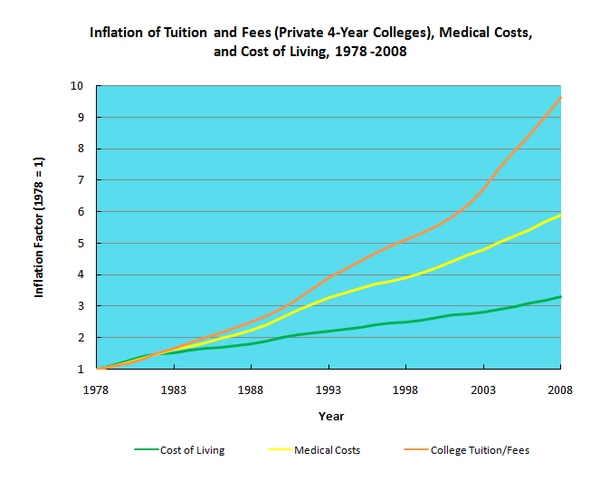
The above graph (CollegeBoard) shows that increase in college tuition fee has far exceeded inflation rates in the US.  Considering most colleges, at least, the state universities are non-profit institutions, what could be the reason behind this sharp increase in tuition fees?

There are several theories floating in the academic circles, including, a potential "higher education bubble", or a decrease in government appropriation into the education system, mismanagement of endowments, and lack of consumer protection.  Personally, I posit that the federal students loans program has played a large role in not only raising college tuition, but also herding our top engineering and science students into the corporate and banking sector.

Since the federal government started providing low interest student loans to make education more affordable, this increased the market for higher education, allowing universities and colleges to hike up their tuition fees by recognizing that now more students had access to money to afford these higher fees.  Unfortunately, this system led to students graduating college with massive amounts of debt, and instead of pursuing vocations they were really interested in, were forced into majoring in subjects that would provide the maximum employment opportunity upon graduation.  This phenomenon caused a large increase in students pursuing subjects like economics and finance, and of course, the ubiquitous MBA.

Why does an MBA cost so much when one can learn pretty much all the material through Khan Academy and a library card (read Good Will Hunting) in six months.  Well, first, it provides you with a stamp of legitimacy - we live in a paradigm of label-able education.  Although in my opinion, knowledge and literacy almost has nothing to do with being educated.  I have found many "MBAs" pretentious and arrogant [3].  Even worse is the increasing trend of engineers pursuing MBAs to take up corporate management positions, ridding the world of clever engineers and replacing them with greed infused suits.  Second, this "need" to do an MBA has made the demand for the degree sky rocket allowing schools to charge fees which in any other profession would be called highway robbery...

So, the banking system, through their loans, allows colleges to increase their tuition, encumbering students with massive loans so they end up taking jobs with the said banks after they graduate... an unusually unhealthy system.  Can we break down this system?  Should the US federal government stop giving out low interest loans?  Should education be completely free market?  Doesn't that skew the level playing field then?  Should governments cap tuition fees like in the UK, or make colleges free like in Europe?  Whoa, that sounds like socialism...  I don't have the answers, but it's something to think about.

Addendum: 24 September 2014
Here is John Oliver's ("Last Week Tonight with John Oliver") brilliant and hilarious take on the Student Debt Crisis, from an angle I had never considered before.  Consider meself suitably humbled.


[1] Understand that Investment Banks do not actually invest in ideas... they invest in existing businesses for vast commissions.  While IBs may also be adding to the real economy, they do not necessarily push for innovation.  An IBs primary goals are M&A, financing solutions, corporate consulting and risk management, and investment solutions.  This is vastly different from VCs.  Similarly, merchant, corporate and commercial banks do also invest into new businesses but deal with vast capital and not particularly with new ideas.

[2] Let us, for the sake of argument, ignore the manner in which banks create fictitious wealth through complex financial instruments that serve no purpose but to sponsor bonus checks.

[3] I remember a person once tried to get me to buy into an Amway type pyramid scheme, and when I painstakingly pointed out all the inherent fallacies in his arguments, he asked me with a sneer, "Do you have an MBA?"  "No", I had replied.  "Well I do, and I'm telling you this works."  Case closed.

Monday, June 09, 2014

The Problem With Patriotism

I recently read Ramchandra Guha's article in HT, entitled, "Excessive love of one’s state is less harmful than that of one’s country", which talks about regional pride in literature and culture.  This debate was sparked by Guha's comparison of Kannada polymath Shivarama Karanth with Bengali literary god, Rabindranath Tagore.  I am not interested in this argument.  Personally, I believe, Bengali intellectualism and literary elitism is in decline and like the British, we are living off by selling the family silver (so to speak).  

No, what I am more interested in is exploring the idea of patriotism.  Being blindly loyal to some arbitrary division of land or world view, is an idea so abstract that I can't really fathom the need or requirement for it.  To me, patriotism, for country, religion, or an idea, if anything, is detrimental to the fabric of tolerant societies and a marker for regression.  In Tagore's poem, Where the Mind is Without Fear, he writes, and I paraphrase, "...let me awake in a world that is not broken up by narrow domestic walls" - a sentiment that resonates with me.

When I was backpacking through Europe several years ago, the political pub talk revolved around the wisdom of including the ten new countries to the European Union.  What was most striking about these conversations, and we see in the political set up of Europe today, is the rise of right wing sentiments in Western Europe.  In the recent EU elections, the anti-EU parties enjoyed a significant bump as outlined by this Telegraph article in May.

In my limited opinion, this "right-wing swing" is essentially a form of xenophobia in disguise.  The EU, I always felt, was the natural direction of humanity's future, a step towards global political and social unification, but it seems our basic need for a "us and them" framework is too overwhelming.  Give us aliens to fight and we're going to come together, otherwise we're going to find our own aliens... in the case of Europe, that's everyone who isn't, well, Western European.

Part of this "us and them" mentality is buried under the guise of patriotism.  "Self-interest" and "self-preservation" is tantamount to patriotism, and it is this kind of backward thinking that negates the momentum towards a politically and socially cohesive world.

In the context of India and Pakistan, patriotism rears its head when we're playing a cricket match or we're at war, and somehow brings out the worst in our generalizations about each other.  I've met many Pakistanis in my life and I've enjoyed their company very much.  Of course, that in itself is a generalization, and probably holds true for the 1 percent liberally educated urban youth I have interacted with.  My point is that we have no right to use the label of patriotism for actions and words that dehumanize people in a country, idea, or religion that is not ours.  Patriotism, like the practice of religion should be private and personal.  Rather than slap on some face paint when there is a cricket match, if we were really patriotic, we would treat our fellow citizens with respect, and not urinate by the side of the road or treat the country like shit.

I am aware of the argument that the need for barriers is seeded in animal instinct.  Chimpanzees, wolves and other animals that live in some form of social structure, display tendencies of divisiveness; acting in the interest of the pack or herd against other packs or herds.  However, considering we have put a human on the moon, is it really a legitimate argument to claim animal instinct as the basis for the most divisive notion we have in society?  Can we not say that, we, as a species, are better than wolves? [1]

All patriotism has really done is reinforce the imaginary boundaries that separate groups of people, who in all likelihood, under other circumstances could get along.  I'm not trying to demean the idea of patriotism, just the way we practice it today [2].

[1] The same applies to religion.
[2] I have nothing against wolves per se.

Monday, May 12, 2014

"Regression analysis is more art than science" [1]

Steven Levitt and Stephen Dubner showed us in Freakonomics how the world of correlation and regression can show curious links between seemingly unrelated subject matter - culminating in a thesis relating legalization of abortion and crime rates in the United States.

Here is another view - Correlation can yield absolutely absurd results...
My favorite is "Divorce Rates in Maine" against "Consumption of Margarine in the US"

As Twain said, "There are lies, and then there are statistics"...

[1] Steven Levitt